

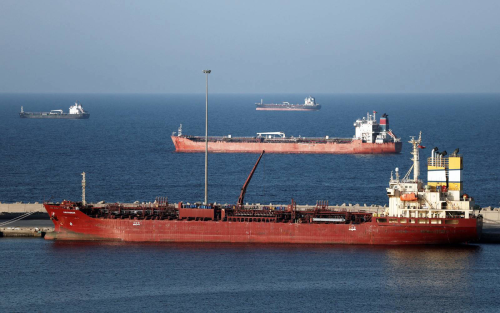
The global tanker industry has issued a firm rejection of Iran’s demand for transit fees to pass through the Strait of Hormuz, warning ship operators not to pay and declaring the waterway still unsafe even as United States and Iranian negotiators meet in Islamabad to stabilise a fragile ceasefire.
Phillip Belcher, a senior official at Intertanko, an association representing 190 independent tanker operators and more than half of the world’s oil tanker fleet, told the BBC on Saturday that the industry remained fully opposed to Iran’s toll proposal and had advised members to stay away from the strait entirely. Belcher said an attack on any vessel attempting transit remained possible at any time and that the waterway was currently under the de facto control of the Iranian military.
Iran has indicated that ships seeking to pass through the strait must coordinate directly with its armed forces or risk being targeted. Reports suggest Tehran is planning to formalise fees of up to two million US dollars per ship, with some vessels already reported to have paid in Chinese yuan or cryptocurrency to secure passage. Belcher said his organisation was particularly concerned because the entity exercising control over the waterway is Iran’s Islamic Revolutionary Guard Corps (IRGC), which both the United States and the European Union have designated as a terrorist organisation.
The International Maritime Organisation (IMO), the United Nations agency overseeing global shipping safety, has aligned with the industry position. IMO Secretary-General Arsenio Dominguez told the BBC that imposing any fee on vessels transiting an international strait violates established principles of freedom of navigation under the United Nations Convention on the Law of the Sea (UNCLOS), which guarantees that no toll or restriction may be applied to international straits.
The toll question has also complicated the US position. President Donald Trump initially suggested the United States and Iran could jointly operate a toll system on the strait, describing it as a potential “joint venture,” but subsequently reversed course, warning Iran to stop collecting fees immediately. The White House has since stated that the ceasefire depends on the strait reopening without any limitations, including tolls.
The scale of the disruption remains severe. Only 15 vessels have transited the Strait of Hormuz since the ceasefire was announced on Tuesday, compared to an average of more than 130 ships per day before the conflict began on February 28. Nearly 800 ships remain stranded in the Gulf, the majority loaded with cargo. Oil prices have climbed back above 95 US dollars per barrel as the ceasefire has failed to restore meaningful shipping flows.
Erik Hanell, chief executive of Swedish tanker company Stena Bulk, said his firm would not move until it had full safety guarantees and would not pay any fees as a standalone operator. He said the longer-term prospect of permanent Hormuz tolls would represent a fundamental rupture with the established global maritime order, comparing it to being charged to sail through the English Channel.
The toll dispute has emerged as one of the most contentious issues at the Islamabad talks, where Vice President JD Vance is leading the US delegation in proximity negotiations with Iranian representatives under Pakistani mediation. A resolution that permits Iran to maintain any form of de facto fee or access control over the strait would set a precedent with far-reaching consequences for global shipping costs, energy prices, and the rules governing free passage through international waters.

