

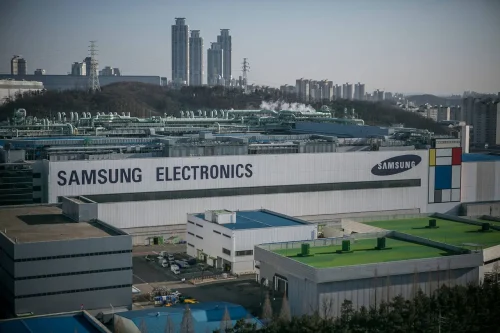
Samsung Electronics became only the second Asian company in history to cross a $1 trillion market valuation on Wednesday, as shares surged more than 14 percent in Seoul on the back of record quarterly earnings and surging global demand for artificial intelligence hardware.
Samsung’s market value reached 1,500 trillion won, equivalent to $1.03 trillion, in early Seoul trading, tracking sharp overnight gains in AI-related stocks in the United States. The milestone makes Samsung only the second Asian firm after Taiwan Semiconductor Manufacturing Company (TSMC) to reach that mark, and Samsung’s gain pushed the benchmark KOSPI index more than 6 percent higher, driving it above 7,000 for the first time.
The rally followed Samsung’s record first-quarter earnings, in which operating profit surged more than eightfold to 57.2 trillion won, while revenue climbed to a record 133.9 trillion won. Samsung’s first-quarter operating profit alone exceeded its full-year 2025 profit of 43.6 trillion won.
The gains were also amplified by a Bloomberg report that Apple has held exploratory talks with Samsung and Intel about producing chips for Apple devices in the United States, potentially diversifying beyond longtime supplier TSMC.
At the centre of the earnings surge is a structural shortage in memory chips. Analysts say there is a tremendous shortage in Dynamic Random Access Memory (DRAM) and NAND flash memory chips driven by AI demand, which is highly memory-intensive due to its high bandwidth and storage requirements. New semiconductor capacity typically takes two to three years to come online, analysts note, meaning supply constraints are likely to persist well into 2027.
Samsung’s semiconductor arm delivered a 48-fold jump in profit in the March quarter as AI data centre orders delivered hefty margins, and analysts expect the division to build on its record performance over the next several quarters as contract prices continue to rise.
Samsung joins a group of thirteen companies worldwide that have previously achieved the $1 trillion milestone, including Nvidia, Alphabet, Apple, Microsoft, Amazon, Broadcom, Saudi Aramco, Meta, Tesla, Walmart and Berkshire Hathaway.
Investors are now debating whether the memory sector has broken out of its historically cyclical pattern. “The trillion dollar threshold carries material weight beyond the symbolism. It reflects a market judgment that memory’s role in the AI infrastructure stack is structural, not cyclical,” said Dave Mazza, chief executive of Roundhill Investments.
Risks remain. Samsung still faces intense competition in high-bandwidth memory from rival SK Hynix, and a slowdown in consumer electronics demand could weigh on revenue if AI-driven orders moderate. For now, however, the market’s verdict is clear: chipmakers have moved to the centre of the global technology hierarchy.

