

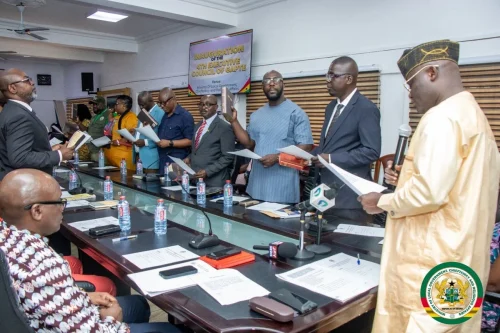
The Minister for Local Government, Chieftaincy and Religious Affairs, Ahmed Ibrahim, has inaugurated the 4th Executive Council of the Greater Accra Passenger Transport Executive (GAPTE), issuing a blunt warning that Accra’s chronically troubled urban transport system must show measurable transformation within six months or leadership will face consequences.
Speaking at the inauguration, the Minister expressed concern about the current state of urban transport in the Greater Accra Region, stressing that the time for excuses is over. “The expectation is clear — within six months, Ghanaians must see a transformation. Anything short of that will not be accepted,” he said.
The 34-member council was drawn from the ministries of Local Government, Finance, and Transport, all 29 metropolitan, municipal and district chief executives (MMDCEs) in the Greater Accra Region, and representatives from GAPTE, the Greater Accra Regional Coordinating Council, the Department of Urban Roads, and the Motor Traffic and Transport Division (MTTD) of the Ghana Police Service.
Aayalolo at the Centre of Reform
The minister placed the revival of the Aayalolo Bus Rapid Transit (BRT) system at the heart of his charge to the new council. As of January 2026, only 80 of the 245 Aayalolo buses procured in 2016 were operational due to maintenance and financial challenges. The system, originally launched under a $95 million project backed by the World Bank and international development partners, has struggled for years without dedicated bus lanes and with a shrinking operational fleet.
Ibrahim directed the council to revamp the Aayalolo BRT services for effective urban traffic management, and to take immediate steps to reclaim all GAPTE properties currently in private hands and put them to beneficial use. “I charge this council to ensure that you go to Kinbu, Adenta, Kasoa, and reclaim GAPTE’s properties that have been given to private operators. Whoever gave those facilities out has not done us any good, and we must rescue the facilities,” he said.
He also linked the Aayalolo revival directly to the government’s broader economic agenda. “Aayalolo must be revamped to provide 24-hour services to ensure effective and efficient public transport in GAMA in tandem with the 24-Hour Economy Policy,” he told council members.
The Scale of the Problem
The minister cited sobering data to frame the urgency of reform. Accra, with a population of approximately 5 million, contributes between 34 and 39 percent of Ghana’s gross domestic product (GDP), yet the Greater Accra Metropolitan Area (GAMA) operates with a 58 percent road network deficit, having only 7,600 kilometres of the 19,000 kilometres required. Traffic on key corridors is growing by up to 15 percent annually, while average road speeds on main roads have fallen to just 28 kilometres per hour.
The human cost is equally stark. In 2023, Greater Accra recorded over 14,000 road crashes resulting in more than 2,000 fatalities, and the first quarter of 2025 alone saw a 23.5 percent increase in road traffic deaths compared to the prior year. At Korle-Bu Teaching Hospital, 62 percent of emergency department fatalities are attributed to road traffic accidents. Air pollution from vehicles contributes to nearly 50 percent of Accra’s hazardous air quality, and estimates suggest that in 2019 alone, approximately 3,000 individuals died prematurely from transport-related pollution.
For ordinary commuters, 70 percent of people in GAMA depend on informal trotro services, yet only 14 percent of built-up areas have five-minute walking access to public transport. Workers spend an average of 58 minutes per trip, and many residents endure daily commutes exceeding three hours, consuming 15 percent or more of household income on transport costs.
A Call for Cross-Jurisdictional Action
Ibrahim framed the challenge as one that demands collaboration across administrative boundaries, not piecemeal efforts from individual districts. He asked the council to ensure the establishment of transport departments across all metropolitan, municipal and district assemblies (MMDAs) in the Greater Accra Region, and stressed that coordinating across 27 Metropolitan, Municipal and District Assemblies (MMDAs) would require patience, persistence and political will.
“The decisions you make during your tenure will shape GAMA’s development for the next 3 to 5 decades,” the minister told the council.
GAPTE was conceptualised under the Ghana Urban Transport Project (GUTP) as part of the Accra Modernisation Initiative in 2005, with the primary mandate to undertake transport planning, network development and public transport regulation within GAMA.

