

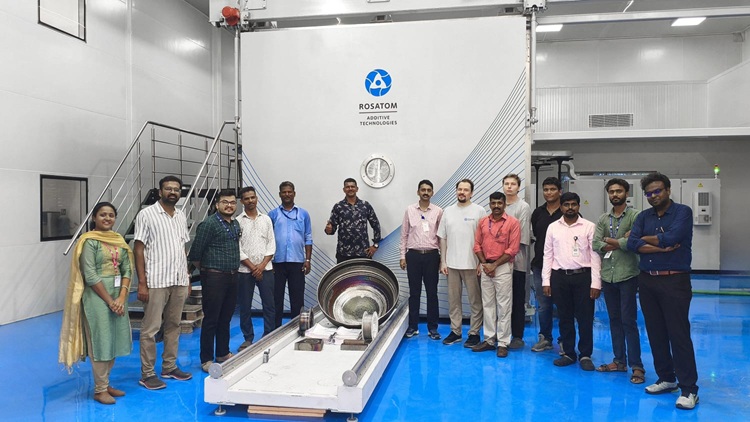
India has commissioned its largest industrial 3D printer for aerospace manufacturing, supplied by Russian state corporation Rosatom, in a development that significantly advances the country’s capacity to produce space-grade metal components.
The machine, designated the RusBeam 2800, operates on Electron Beam Additive Manufacturing (EBAM) technology, in which a high-powered electron beam melts metal wire layer by layer inside a vacuum chamber to build large-scale parts. The vacuum environment makes the process particularly suited to processing reactive and refractory alloys critical to aerospace and nuclear applications, where material integrity under extreme conditions is non-negotiable.
Custom-built for the Indian client using Rosatom’s proprietary software, the RusBeam 2800 can produce components up to 2.8 metres tall and weighing up to four tonnes. At a print speed of 50 millimetres per second, a 50-kilogram part is completed in five hours. The printer works with titanium, nickel, cobalt-chrome alloys, and high-performance superalloys.
“We are already in discussions with our Indian partners regarding further supplies,” said Rosatom Director General Alexey Likhachev, adding that joint research and development in additive technologies and potential localisation of equipment manufacturing in India are under active consideration.
For the Indian Space Research Organisation (ISRO), the technology sharply reduces lead times for large aerospace components while preserving material integrity under deep-space conditions. The printer is expected to support missions including Gaganyaan, India’s crewed spaceflight programme, the proposed Bharatiya Antariksh Space Station, and the Chandrayaan lunar exploration series.
Additive manufacturing eliminates the tooling, casting, and milling stages required by conventional production. Complex assemblies previously built by welding multiple elements can now be grown as single pieces, with metal utilisation approaching 90%. End-of-life manufacturing costs can fall by up to 90% due to near-zero material waste, as feedstock is recycled through the process.
Likhachev connected the supply to the bilateral technology partnership formalised at the December 2025 summit between Russian President Vladimir Putin and Indian Prime Minister Narendra Modi, where both governments committed to deeper cooperation in space, peaceful nuclear energy, and non-nuclear technology applications.
The commissioning also signals that Russian EBAM technology has reached industrial export readiness, positioning it as a credible alternative to Western and American equipment in a market where supplier diversity has long been limited.
For Ghana, which launched its first satellite, GhanaSat-1, in 2017 and is actively building national space infrastructure through a recently approved space policy and a developing space agency, the global expansion of advanced additive manufacturing presents a timely reference point as the country works to grow its engineering capacity and industrial base.

