

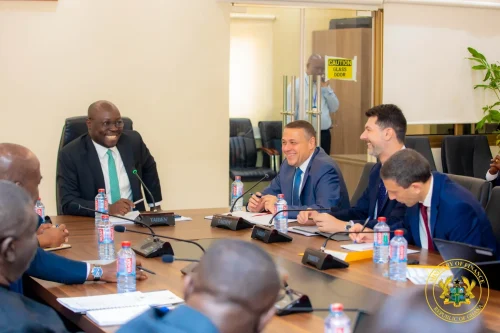
A visiting team from the International Monetary Fund (IMF) has wrapped up its sixth review mission in Ghana following weeks of engagements with government officials and stakeholders in Accra, with questions remaining over whether a staff-level agreement has been secured.
Sources familiar with the discussions say Ghana made significant progress on key programme targets and structural benchmarks under its IMF-supported Extended Credit Facility (ECF) arrangement, though some issues remained unresolved at the close of the mission. Since entering the programme in 2023, each completed review has ended with a staff-level agreement. As of Friday, it was unclear whether that outcome had been achieved in this cycle. Clarity is expected when government officials and the IMF team hold a joint press conference later in the day.
It also remains unknown whether the Fund will outline prior actions Ghana must complete before the programme advances to the IMF Executive Board for consideration in August 2026.
The sixth review assessed Ghana’s performance since earlier this year, with discussions focusing on fiscal pressures in the energy sector, broader structural reforms, and debt management. In the monetary and banking sector, sources indicate progress was made across most areas, with at least one issue still outstanding.
Finance Minister Cassiel Ato Forson, addressing the IMF team at the start of the mission, described Ghana’s record since the 2022 economic crisis as reflecting disciplined policy decisions taken in the national interest. “It has been a long, demanding, but ultimately transformative journey,” he said. He added that the next phase of the programme would centre on private sector growth and ensuring macroeconomic stability generates tangible employment and investment outcomes for Ghanaians.
Ghana’s 36-month ECF programme, approved in May 2023, provides access to Special Drawing Rights (SDR) 2.24 billion, equivalent to approximately $3 billion. At the fifth review, the IMF described Ghana’s performance as broadly satisfactory despite some reform delays. The Bank of Ghana has since built foreign reserves to record levels, strengthening the country’s buffers against external shocks.
The IMF maintains Ghana’s 2026 growth forecast at 4.8 percent, slightly above the Sub-Saharan Africa average, and projects inflation declining to 7.9 percent, with price growth potentially remaining in single digits through 2027.

