

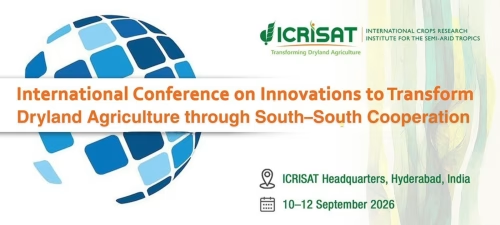
The International Crops Research Institute for the Semi-Arid Tropics (ICRISAT) has announced an international conference focused on innovations to transform dryland agriculture through South South Cooperation, scheduled for September 10 to 12, 2026 at ICRISAT Headquarters in Patancheru, Telangana, India.
The conference will bring together leaders from the Global South and beyond to advance practical, science based and partnership driven agricultural solutions for dryland food systems, which support the world’s most climate vulnerable communities.
Dr. Himanshu Pathak, ICRISAT Director General, said the conference will provide a high level platform to accelerate collaboration, knowledge exchange and technology deployment, from crop improvement and seed systems to frontier science and next generation cropping systems, anchored in the spirit of South South Cooperation.
“ICRISAT has been making steady progress in leveraging South South collaboration to transform dryland agriculture through its flagship initiative, ICRISAT Center of Excellence for South-South Cooperation in Agriculture (ISSCA). This conference will serve as a global platform to showcase innovations that can transform dryland agriculture, where climate risk is highest and the need for resilient livelihood is most urgent,” Dr. Pathak stated in Tuesday’s announcement.
The conference dates align with the United Nations Day for South South Cooperation on September 12, underscoring the importance of peer to peer learning, shared innovation pathways and strengthened partnerships across Africa, Asia, Latin America and the Pacific.
Dr. Stanford Blade, Deputy Director General for Research and Innovation at ICRISAT, emphasized that the conference aims to connect cutting edge science with practical applications for smallholder farmers in dryland regions.
“From functional genomics to farmer ready seed delivery, the conference aims to connect cutting edge science through its dynamic focus areas and spotlight solutions that work for smallholder farmers and dryland regions,” Dr. Blade said.
The conference program is being developed in consultation with partners and stakeholders. Proposed sections include the United Nations Day for South South Cooperation on September 12, the drylands challenges, climate change and its impact on food and nutritional security, the next generation of dryland cropping systems, and what the dryland crops of the future will look like.
Additional focus areas will cover understanding and utilizing genebank diversity, frontier technologies for dryland crop improvement including genomic predictions and speed breeding, genomic assisted breeding for climate resilient and biofortified crops, and functional genomics and gene editing to transform dryland crops.
The agenda will also address seed delivery systems, food nutrition and bioavailability, how to attract youth into the agrifood ecosystem, and youth involvement in management of dryland crops.
Drylands cover about 41 percent of the earth’s land surface and are inhabited by more than 2.1 billion people residing in the drylands of Asia, Sub Saharan Africa and beyond. These regions are characterized by poverty, food insecurity, malnutrition, frequent drought and environmental degradation that adversely impact those who live there.
ICRISAT has positioned itself at the forefront of developing context specific solutions for dryland agricultural communities. Its innovations include the world’s first commercial pigeonpea hybrid, the first machine harvestable chickpea and Africa’s first biofortified pearl millet. These breakthroughs enhance food and nutritional security while showcasing scientific leadership emerging from the Global South.
The September 2026 conference builds on ICRISAT’s recent initiatives to strengthen South South cooperation. In June 2025, ICRISAT partnered with the Research and Information System for Developing Countries (RIS), India’s Ministry of Agriculture and other organizations to launch the ICRISAT Center of Excellence for South-South Cooperation in Agriculture (ISSCA) during the Conference on Global South and Triangular Cooperation in New Delhi.
ISSCA serves as a catalyst for translating proven agricultural solutions into scalable impact. It features a digital portal that functions as a living repository of validated innovations, enabling peer to peer learning, partnership brokering and deployment of low cost, high impact technologies and policy models tailored to dryland and developing regions.
Speaking at the ISSCA launch in June, Dr. Pathak emphasized that the Global South possesses a rich foundation of innovation, local expertise and proven solutions, but more coordinated action, investment and partnership are needed to unlock their full potential at scale.
“The establishment of ISSCA reflects ICRISAT’s commitment to supporting countries of the Global South in leading their own agricultural transformation, powered by science, enabled by strong partnerships, and aligned with inclusive growth goals,” he stated.
In September 2025, ICRISAT marked the UN International Day for South South Cooperation with a high level webinar titled “Scalable Solutions for Crop Improvement and Production Technologies for the Global South” under the ISSCA platform. The event attracted over 1,000 participants from across the globe.
During that webinar, Dr. Pathak highlighted that it is not just the scientific output but how knowledge is shared and inspiration is spread that matters for agricultural transformation. The event demonstrated strong appetite for enhanced cooperation among Global South countries facing similar agricultural and climate challenges.
ICRISAT invites research and academic institutions, national agricultural research systems, governments, development partners, private sector innovators, CGIAR centers and youth led agrifood enterprises to save the dates and follow upcoming announcements on registration, program tracks and partnership opportunities.
The institute was established under a Memorandum of Agreement between the Government of India and CGIAR on March 28, 1972. In accordance with the Headquarters Agreement, the Government of India extended the status of a specified “International Organisation” to ICRISAT under section 3 of the United Nations (Privileges and Immunities) Act, 1947 of the Republic of India.
For over five decades, ICRISAT has pioneered cost effective and scalable solutions empowering farming communities through advanced research, technology and partnerships. The institute’s work addresses farmers’ diverse challenges, from adapting to climate change to bolstering soil health, water management and market connections.
Dr. Pathak assumed charge as ICRISAT Director General on March 6, 2025, bringing extensive experience from his previous roles as Secretary of the Department of Agricultural Research and Education (DARE) and Director General of the Indian Council of Agricultural Research (ICAR). He holds a BSc in Agriculture from Banaras Hindu University and earned his MSc and PhD in Soil Science and Agricultural Chemistry from the Indian Agricultural Research Institute.
Dr. Blade joined ICRISAT as Deputy Director General for Research in April 2024 before serving as interim Director General during the leadership transition. He holds a PhD from McGill University for plant breeding and cropping systems research conducted at the International Institute of Tropical Agriculture (IITA). In 2018, he was named an International Fellow of the Royal Swedish Academy of Agriculture and Forestry.
The institute currently operates research stations across India and maintains a significant presence in several African countries including Kenya, Nigeria, Mali, Niger and Ethiopia. ICRISAT works with national agricultural research systems, universities, non governmental organizations and private sector partners to develop and disseminate agricultural technologies suited to dryland conditions.
Recent research initiatives include developing drought tolerant crop varieties, improving water use efficiency through watershed management, advancing precision agriculture using digital tools, strengthening seed systems for smallholder farmers and enhancing market linkages to improve farmer incomes.
The World Bank estimates that up to 216 million people could be forced to migrate within their own countries by 2050 as climate impacts intensify, most of them in Africa and South Asia. Investing in resilient food systems in the Global South is increasingly recognized as one of the most effective strategies for ensuring regional and global stability.
ICRISAT’s work addresses this challenge by helping communities turn drylands into zones of opportunity. In India’s Bundelkhand region, science led watershed interventions have transformed parched wastelands into thriving, water abundant croplands. In Niger, climate resilient seed systems are transforming uncertainty into productivity through drought tolerant sorghum and pearl millet varieties.
The September 2026 conference represents an opportunity to accelerate such transformations by facilitating knowledge exchange and partnership building among countries and institutions facing similar challenges in dryland agriculture.
More information, including the conference webpage and call for participation details, will be shared through ICRISAT’s official channels in early 2026. Organizations interested in participating, sponsoring or partnering on the conference can contact ICRISAT through its headquarters in Patancheru, Hyderabad.
The conference is expected to attract several hundred participants from national agricultural research systems, universities, CGIAR centers, development agencies, private sector companies, non governmental organizations and farmer organizations working on dryland agriculture across the Global South.
As climate change continues to intensify pressures on dryland agricultural systems, the conference aims to showcase innovations that can help the 2.1 billion people dependent on these systems build resilience, improve food security and enhance livelihoods despite increasingly challenging environmental conditions.

