

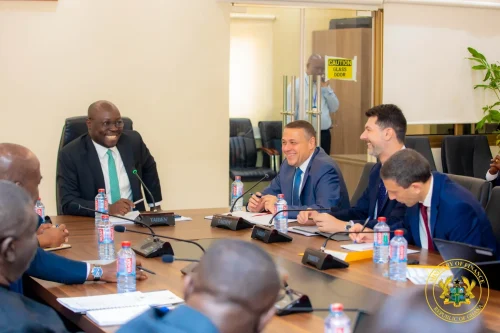
When Finance Minister Dr. Cassiel Ato Forson received an International Monetary Fund (IMF) mission team at his office in Accra on April 29, led by Dr. Ruben Atoyan, he described the three years since Ghana’s debt default as a journey that was “long, demanding, but ultimately transformative.” The numbers backing that assessment are, by any honest reading, remarkable.
Ghana’s debt-to-GDP ratio has fallen from 61.8 percent to 45.3 percent, ahead of earlier consolidation targets. The primary fiscal balance shifted from a deficit of 2.9 percent of gross domestic product (GDP) to a surplus of 2.6 percent. Inflation, which peaked above 54 percent in December 2022, has fallen to 3.2 percent as of March 2026. The cedi appreciated more than 40 percent against the US dollar in 2025, its first annual gain in over three decades. International reserves now stand at $13.8 billion, covering 5.7 months of imports. Ghana also returned to the domestic bond market after a three-year absence, raising GH₵2.7 billion through a seven-year bond that was oversubscribed. These are not peripheral indicators. They represent a genuine macroeconomic turnaround from one of the most severe crises in the country’s post-independence history.
The sixth and final review, now underway, is expected to conclude within two weeks. The IMF’s Extended Credit Facility (ECF) programme will formally end in August 2026, a three-month technical extension from the original May deadline to allow reviewers time to analyse full-year 2025 and first-quarter 2026 data. There is no suggestion of trouble. The extension is procedural.
But the more consequential question begins precisely when the programme ends: whether the discipline that produced these numbers can survive without the IMF’s monthly monitoring, disbursement pressure, and institutional capacity to force difficult decisions. Ghana has been through this before. Seventeen times, in fact. It entered an IMF programme in 2009, stabilised impressively, then allowed spending to surge ahead of the 2012 elections. The gains unwound, the deficits returned, and by late 2022, the country was back at the Fund’s door with a debt default and a currency in freefall.
Forson has tried to address this structural vulnerability through legislative architecture rather than political promises. An amendment to the Public Financial Management Act (PFMA) now establishes a 1.5 percent primary surplus rule and a 45 percent debt ceiling, rules designed to bind future governments, not just the current one. A proposed Loans Act would restrict government borrowing to projects with demonstrable economic returns. An Independent Fiscal Council (IFC), created under amended Public Financial Management Act 1136, is expected to be fully operational by the time the programme concludes, providing institutional oversight after the IMF stops watching.
Whether these structures hold will be tested by dynamics that legislation alone cannot fully contain. President John Dramani Mahama, speaking during his Northern Region tour on April 18, pledged that fiscal discipline would continue beyond the programme. “We are almost coming out of the IMF programme, but we want to keep the fiscal discipline,” he said. It is precisely the kind of statement every Ghanaian leader has made at this moment in previous cycles. The difference this time, if there is one, lies in whether the institutional framework is robust enough to make the commitment binding regardless of who makes it.
The IMF has revised Ghana’s 2026 growth forecast upward to 4.8 percent, reflecting stronger-than-expected programme performance. It has also cautioned that the post-programme period is precisely when fiscal slippage has historically re-emerged. The energy sector, where debt management and pricing reforms remain incomplete, is expected to feature prominently in the sixth review. Social protection expenditure will also receive attention, as the human cost of the stabilisation programme, including a domestic debt restructuring that wiped out pension and savings portfolios, has not been evenly distributed.
The fiscal rules are written. The Fiscal Council is planned. The debt ceiling is law. The bond market is open. Whether any of it holds will be determined not by economists in Washington, but by decisions made in Accra, and eventually, on the campaign trail.

