

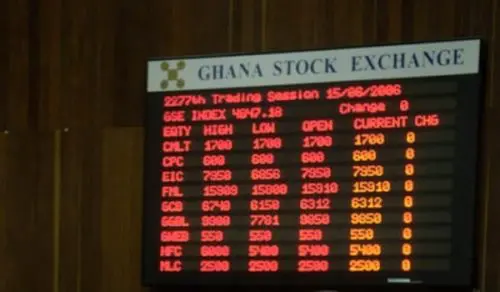
The Ghana Stock Exchange recorded gains across both major indices on Thursday, December 18, 2025, as market capitalization expanded to 168.97 billion cedis in the 7116th trading session.
The GSE Composite Index advanced 24.01 points to close at 8,745.74, rising from Wednesday’s 8,721.73. The GSE Financial Stocks Index gained 32.99 points to settle at 4,616.20, up from the previous session’s 4,583.21. Trading volume declined to 1.52 million shares valued at 6.15 million cedis, down from Wednesday’s 4.83 million shares worth 6.61 million cedis.
Market capitalization has grown steadily throughout the week, advancing from 168.16 billion cedis on Monday to 168.52 billion cedis on Tuesday before reaching 168.69 billion cedis on Wednesday and climbing to the current 168.97 billion cedis. The consistent expansion reflects improved company valuations and sustained investor confidence as the exchange approaches year end.
Year to date performance continues to demonstrate exceptional growth across both indices. The GSE Composite Index has surged 78.90 percent since January 1, 2025, while the GSE Financial Stocks Index has gained 93.89 percent over the same period. These returns position Ghana’s bourse among Africa’s best performing stock markets for the year, reflecting the country’s emergence from a severe debt crisis that threatened financial stability in 2022 and 2023.
Thursday’s modest trading volume of 1.52 million shares represented a significant decline from Wednesday’s activity but remained consistent with patterns observed earlier in the week. Monday saw 1.34 million shares traded valued at 4.91 million cedis, while Tuesday recorded the week’s highest volume at 4.62 million shares worth 19.58 million cedis. The fluctuating activity levels reflect typical portfolio adjustment patterns as institutional investors rebalance allocations heading into year end.
The Financial Stocks Index’s stronger year to date performance compared to the composite index underscores sustained investor appetite for banking and financial services stocks. Financial sector companies have posted strong quarterly results driven by higher net interest margins, growing loan books and declining impairment charges throughout 2025. Improved asset quality and lower provisioning requirements have contributed to sector profitability as economic conditions normalize.
Banks have benefited from the stabilization of Ghana’s macroeconomic environment following completion of the domestic debt exchange programme in 2023 and subsequent International Monetary Fund programme implementation. Treasury bill rates have fallen dramatically from 28.9 percent to 10.7 percent, the lowest in 14 years, making equities relatively more attractive compared to fixed income securities. This shift has channeled significant investment flows into stocks, particularly banking shares.
Inflation declined from 23.8 percent in December 2024 to 6.3 percent in November 2025, falling below the Bank of Ghana’s target range for the first time since 2021. The dramatic improvement in price stability has created a more favorable environment for equity investments and supported corporate earnings growth across most sectors. The cedi has appreciated roughly 35 percent against major currencies this year, further enhancing returns for international investors.
Corporate earnings season for the third quarter of 2025 generally exceeded expectations, with most listed companies reporting revenue growth and improved profitability. The positive results have reinforced investor confidence and provided fundamental support for stock price appreciation. Finance Minister Dr Cassiel Ato Forson’s 2026 budget outlined measures designed to sustain macroeconomic stability while supporting private sector growth, targeting real GDP growth of 4.8 percent and inflation of 8 percent for 2026.
The Bank of Ghana has responded to improved economic conditions by cutting its benchmark policy rate from 21.5 percent to 18 percent, marking the first monetary policy loosening after an extended tightening cycle. Lower interest rates have supported economic activity while maintaining price stability as inflation continues moderating toward single digit levels. Market observers anticipate potential additional rate cuts in 2026 if inflation remains well contained.
The exchange recorded its highest single day trading volume on Friday, December 12, with 13.09 million shares changing hands valued at 12.39 million cedis. That session’s elevated activity reflected strong investor positioning ahead of the weekend and demonstrated the market’s capacity to absorb significant trading flows. The GSE Composite Index closed at 8,679.19 points that Friday, establishing a foundation for the subsequent week’s gains.
Exchange officials have encouraged more companies to list on the GSE to deepen the market and provide investors with greater sectoral diversity. Ghana’s bourse remains relatively small compared to more developed African exchanges in Nigeria, Kenya and South Africa, though its 2025 performance demonstrates its growing significance in the regional investment landscape. The exchange continues implementing technological upgrades and regulatory reforms to improve efficiency, transparency and accessibility for both domestic and international investors.
The GSE is celebrating its tenth anniversary of the Ghana Fixed Income Market during November and December 2025 under the theme Ten Years of the Ghana Fixed Income Market Deepening Markets Expanding Possibilities. The milestone reflects efforts to develop diverse capital market instruments beyond traditional equities. The fixed income platform has traded over one trillion cedis in securities since inception in August 2015, establishing itself as one of Sub Saharan Africa’s most liquid bond markets outside South Africa and Nigeria.
The approach of year end typically brings increased portfolio adjustment activity as institutional investors rebalance allocations and retail investors assess annual performance. December trading historically shows heightened volatility as market participants position for the following year. Sustained stability of Ghana’s economy, corporate earnings trajectory and investor sentiment will likely determine the market’s direction in the final trading sessions of 2025.
Investors continue monitoring domestic economic indicators, monetary policy decisions from the Bank of Ghana, corporate earnings reports and global market trends that influence emerging market equities. The market’s strong performance throughout 2025 has restored confidence among both retail and institutional participants following the challenging 2022 and 2023 period marked by debt restructuring and economic uncertainty.

