

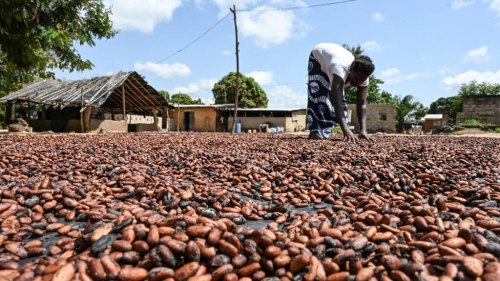
Ghana’s Vice President, Prof. Naana Jane Opoku-Agyemang, has announced the government’s determination to reduce raw cocoa exports by prioritizing large-scale local processing, speaking at the European Union Sustainable Cocoa Initiative in Brussels.
The policy shift represents Ghana’s most ambitious attempt yet to transform its cocoa sector from a commodity supplier into a modern agro-industrial powerhouse. It’s a move that could fundamentally reshape how Africa’s second-largest cocoa producer participates in global chocolate markets.
“Our shared challenge now is to move beyond trade based on commodity dependence towards a partnership built on value addition, sustainability and fairness,” Prof. Opoku-Agyemang told the Brussels gathering. “For Ghana, processing more of our beans at home is both a legitimate aspiration and a strategic imperative.”
The Vice President revealed that ongoing incentives and reforms have already expanded Ghana’s domestic processing capacity to about 500,000 tonnes per annum. That’s a substantial leap forward, though still below the government’s target of processing at least 60 percent of all cocoa produced locally before export.
What makes this push particularly significant is its timing. Ghana and Côte d’Ivoire together contribute over 60 percent of total global cocoa supply and serve as major suppliers for U.S. and European Union manufactured food industries. Any structural changes in how Ghana handles its cocoa could ripple through international markets.
The new policy mix includes targeted tax incentives, financing support, and public-private partnerships designed to encourage investment in value addition facilities. Beyond the large processing plants, government officials are supporting local entrepreneurs to establish small and medium-scale operations across cocoa-growing regions.
“It is no longer sufficient for Ghana to remain a supplier of raw beans,” Prof. Opoku-Agyemang explained. “We are determined to retain more value at home by building the capacity of our local processors and creating a more equitable distribution of wealth within the cocoa sector.”
For decades, Ghana has watched as the bulk of its cocoa beans traveled overseas in raw form, leaving most of the value creation to foreign processors and chocolate manufacturers. The economic logic behind this arrangement has long frustrated policymakers who recognize that processed cocoa products command significantly higher prices than raw beans.
Small-scale processors face particularly steep challenges. Access to credit remains difficult, equipment costs are prohibitive, and breaking into international markets requires certifications that many local operators can’t afford. The Vice President emphasized that government will expand technical assistance programmes to help these enterprises meet international quality standards and sustainability requirements.
The European Union connection isn’t coincidental. The Vice President has challenged global cocoa stakeholders to eliminate tariff escalation practices that prevent African nations from capturing the full value of their cocoa production. These tariff structures typically impose higher duties on processed cocoa products than on raw beans, effectively discouraging value addition in producing countries.
Prof. Opoku-Agyemang urged EU officials, development finance institutions, and private investors to collaborate with Ghana in supporting what she called a “responsible, climate-smart, and traceable cocoa supply chain.” The appeal comes as new EU sustainability and deforestation regulations are reshaping global cocoa trade dynamics.
“We welcome partnerships that ensure our cocoa is not only sustainably sourced but also ethically processed,” she said. “Such cooperation must translate into better prices, better working conditions for farmers, and greater resilience for the industry as a whole.”
Cocoa remains Ghana’s most important agricultural export, contributing nearly 30 percent of total export earnings and supporting millions of livelihoods. Yet the country has historically captured only a fraction of the final value that consumers pay for chocolate products in retail markets.
The strategy includes expanding COCOBOD’s role beyond quality control and marketing, promoting local chocolate manufacturing, and increasing export earnings from finished and semi-finished products such as cocoa liquor, butter, and powder. Success could create thousands of skilled jobs while enhancing Ghana’s negotiating power within global markets.
The Vice President has directly linked the cocoa processing initiative to Ghana’s ambitious 24-hour economy vision, arguing that transforming raw beans into finished products requires the infrastructure, financing, and continuous operations that policy framework envisions.
Industry stakeholders have responded positively to the announcement, though some observers question whether Ghana possesses sufficient infrastructure and technical expertise to achieve the 60 percent processing target in the near term. Previous attempts to boost local processing have faced challenges including power supply inconsistencies, limited access to international markets, and competition from established foreign processors.
International development partners attending the Brussels forum commended Ghana’s renewed emphasis on value addition as a potential model for sustainable agricultural transformation across Africa. Whether the initiative delivers on its promises will depend heavily on sustained political commitment, adequate financing, and genuine cooperation from global chocolate manufacturers.
Prof. Opoku-Agyemang concluded with a vision that resonated beyond cocoa economics. “The future of cocoa must be built on shared prosperity,” she said. “We must ensure that the hardworking farmers who make this industry possible benefit fully from their labour.”
For Ghana’s cocoa farmers, who’ve watched global chocolate prices soar while their own incomes stagnated, that’s not just policy rhetoric. It’s an economic imperative that could determine whether the next generation sees cocoa farming as viable or abandons it for other opportunities.

