

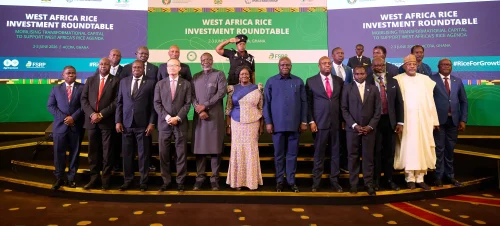
The World Bank has urged West African governments to use guarantees and blended finance to unlock private rice investment, at an Accra roundtable targeting the region’s heavy import dependence.
At the West Africa Rice Investment Roundtable, hosted by Ghana, the Economic Community of West African States (ECOWAS) and the World Bank Group, officials said scarce and costly financing was the main barrier holding the sector back.
World Bank Vice President for Planet Guangzhe Chen said many farmers could not afford fertiliser, seeds and other inputs because credit was too limited or too risky, leaving African fertiliser use far below the global average.
“The solution is de-risking,” Chen said, pointing to guarantees, blended finance and risk sharing tools that could encourage commercial banks to lend to farmers, distributors and agribusinesses.
West Africa still imports a large share of the rice it consumes, with regional output meeting only about 61 percent of demand despite a 44 percent rise in production between 2008 and 2024. Closing that gap is the aim of the Regional Rice Roadmap for 2025 to 2035, which ECOWAS leaders adopted in 2024.
Ghana’s Deputy Finance Minister, Thomas Nyarko Ampem, said the region had not lacked vision but the right kind of capital, calling for patient, risk tolerant investment in irrigation, storage, milling and logistics rather than short term commodity trading.
He argued that investors should treat rice as a single regional industry rather than fragmented national markets, a view echoed by ECOWAS Commission President Omar Alieu Touray, who framed the supply gap as a chance to raise production, strengthen value chains and draw in investment.
The Bank said it was channelling support through AgriConnect, launched in October 2025 to transform farming for about 250 million smallholders worldwide by 2030, and the West Africa Food Systems Resilience Programme, which it said is mobilising around 1.2 billion dollars across eight countries.
Officials stressed that the real test would be delivery, with Touray urging the meeting to move the agenda from planning toward investment and concrete results for farmers, businesses and communities.

