

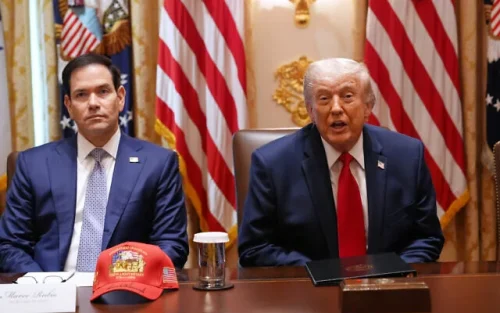
United States President Donald Trump threatened to bomb US ally Oman, conditioned any Iran peace agreement on Gulf states joining the Abraham Accords, and warned that diplomacy was losing momentum, during a White House cabinet meeting on Wednesday that dramatically complicated prospects for ending the nearly three-month conflict.
Trump issued the threat when asked by a reporter whether he would accept a short-term deal allowing Iran and Oman to jointly control the Strait of Hormuz, to which he replied: “Oman will behave just like everybody else, or we’ll have to blow them up.” The White House did not clarify whether the president had misspoken and intended to refer to Iran rather than Oman. The threat came after reports that Iran and Oman were in talks about jointly charging a toll for ships passing through the waterway, a proposal Trump flatly rejected.
Trump signaled at the same cabinet meeting that he may not agree to a deal to end the war with Iran if Saudi Arabia, Qatar and other countries in the region do not join the Abraham Accords, arguing the Gulf nations “owe that to us.”
Trump had pushed the demand the previous weekend in a Truth Social post, writing that after all the work done by the United States to bring the complex diplomatic puzzle together, it “should be mandatory” for those countries to sign onto the accords simultaneously. An official told Axios that the leaders on the call, especially those of Saudi Arabia, Qatar and Pakistan, appeared stunned by the demand, and that there was silence on the line.
Saudi officials were quick to reiterate that Riyadh will only normalize ties with Israel if the latter agrees to establish an irreversible pathway to a Palestinian state, a condition Prime Minister Benjamin Netanyahu has vowed to reject.
When pressed Wednesday on whether he would explicitly make the Iran agreement contingent on those normalizations, Trump stepped back, telling reporters he would not say what was and was not contingent on what.
The session at the White House came shortly after the administration rejected an Iranian state media report as a complete fabrication. The report had claimed a draft Memorandum of Understanding (MOU) between the US and Iran committed Washington to lifting its naval blockade of Iranian coasts and withdrawing forces from the region, in exchange for Iran gradually reopening commercial shipping through the Strait over one month while retaining rights to inspect vessels and impose service fees. Trump explicitly rejected those terms, insisting the waterway must open fully and immediately, serving notice that no nation would hold authority over it.
Trump asserted that Iran is “negotiating on fumes” and insisted that November midterm elections would not push him into rushing a deal. He said the US could make a good deal now, but intended to hold out for a great one.
Secretary of State Marco Rubio acknowledged the slowdown while maintaining that diplomacy remained the preferred path, saying that “some progress” had been made and that Washington would see over the coming hours and days whether further progress was possible. He reiterated that the administration has “other options available” beyond a negotiated settlement. Defense Secretary Pete Hegseth, also present at the meeting, attributed Iran’s negotiating position to military weakness following the joint US-Israeli offensive, warning that no Iranian tanker anywhere in the world is safe under the ongoing naval blockade.
Under the framework that US and Iranian officials have been working toward, Tehran would agree to surrender its stockpile of highly enriched uranium in exchange for sanctions relief. A regional official with direct knowledge of the negotiations said the method of surrendering uranium would be subject to a subsequent 60-day negotiating period, with some likely to be diluted and the rest transferred to a third country.
The Strait of Hormuz carries roughly one fifth of the world’s global oil traffic under normal conditions. Its effective closure since February has pushed energy prices sharply higher and elevated inflation expectations across fuel-importing economies, including those across Africa and the broader developing world. Every day the diplomatic stalemate continues extends the economic pressure on governments managing tight import budgets.
The conflict between the US and Iran erupted on February 28 following large-scale US-Israeli strikes targeting Tehran’s nuclear program. A fragile ceasefire has been in place since April 8, though both sides have retained military postures that leave the situation vulnerable to rapid escalation.

