

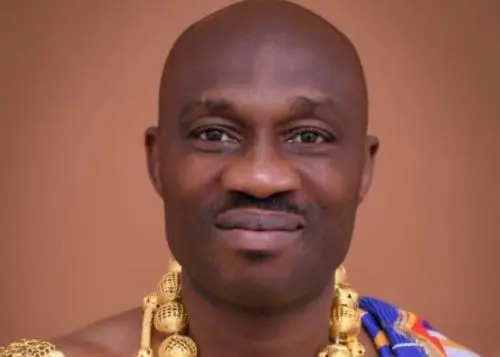
When Wout Hoff, Chief Executive of the Dutch water technology firm Groasis, arrived in Ghana last week for a series of engagements with the country’s top agricultural institutions, one of the figures waiting to welcome him was a traditional ruler.
Nana Kumasah Krampah II, the Omankrado of Gomoa Asempanyin and Amankrakuahen of Gomoa Assin Traditional Area, occupies an unusual position in Ghana’s cocoa sector. He is both a custodian of traditional authority and a board member of the Africa Afforestation Association (AAA), and he has used that dual standing to become a driving force behind a new wave of climate-smart farming in the country’s cocoa belt.
His involvement was central to a six-day training programme that concluded on May 2 in Bekwoie, Ashanti Region, organised by the AAA in partnership with the Forestry Commission and the Ghana Cocoa Board (COCOBOD). The programme introduced over 100 local farmers to cocoa agroforestry, carbon credit opportunities, and the Groasis Waterboxx Method, a Dutch irrigation technology that uses a self-filling container to harvest rainwater and condensation and slowly release moisture to young trees, reducing dependence on rainfall in degraded soils.
Hoff’s visit to Ghana included formal presentations of the Groasis scientific planting method to COCOBOD on April 29 and to the Forestry Commission on April 30, extending the initiative’s reach beyond the farmers in Bekwoie to the institutions that govern Ghana’s cocoa and forestry sectors.
Nana Krampah II, who welcomed Hoff alongside AAA Founder and Chief Executive Light Kwametse Aboetaka, has been explicit about why a traditional leader belongs at the centre of this kind of intervention. “Farming is evolving, and scientific methods are now being adopted worldwide,” he said. “I urge all farmers and agricultural enthusiasts to take advantage of this opportunity to enhance their farming activities and secure our forests for future generations.”
The approach reflects a broader recognition in Ghana’s cocoa sector that community acceptance and technical innovation must move together. Decades of monoculture farming and illegal logging have significantly reduced forest cover in the cocoa belt, and programmes that lack local legitimacy have struggled to achieve lasting results. By positioning a chief as both advocate and convener, the AAA’s model attempts to close that gap.
The Bekwoie programme trained farmers to plant fruit trees and other species alongside cocoa, rebuilding canopy cover while creating additional income streams, including potential earnings from carbon credit markets. The Groasis technology is designed specifically for degraded land where rainfall alone is insufficient to sustain new tree growth, making it particularly relevant for areas of Ghana already bearing the effects of years of deforestation.

