

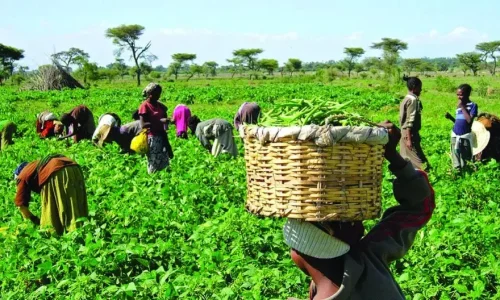
Ghana’s celebrated currency stabilisation is quietly deepening a crisis for the country’s smallholder farmers, with cheaper food imports now undercutting locally grown produce at the point of sale and leaving producers with harvests they cannot sell.
Wepia A. Awal Adugwala, National President of the Peasant Farmers Association of Ghana (PFAG), says the stronger cedi has created a structural paradox where consumers, drawn by lower prices at the market, are choosing imported rice and other commodities over domestic alternatives. In his assessment, this is effectively routing jobs and productive investment out of the country at the expense of Ghanaian growers who are already operating under severe financial strain.
The broader context supports his concern. The cedi emerged as one of the world’s top-performing currencies in 2025, rallying roughly 35 percent against the US dollar, while food inflation fell sharply. But for farmers, the stronger currency has crashed farm-gate prices, leaving an estimated GH₵5 billion in unsold paddy rice sitting in storage, as local prices collapsed faster than market access could absorb the surplus.
Adugwala attributes the competitive gap to a cost structure rooted in systemic policy neglect rather than any deficit in the quality of Ghanaian produce. Local farmers borrow at rates far above what their counterparts in major exporting countries pay, as banks classify agriculture as a high-risk lending category. Inputs including fertiliser, agrochemicals, and tractor services are largely imported and priced accordingly. By the time land rental and labour costs are factored in, the total cost of producing rice, meat, and other staples makes price competition with imports structurally unviable. He noted that farmers in some competing countries access agricultural credit at rates of nearly one percent, a figure that bears no comparison to the lending environment facing Ghanaian smallholders.
To address the import pressure, Adugwala called on government to establish a data-driven framework that maps domestic production capacity against national food demand before any import licences are approved. In his view, the gap between what Ghana produces and what it needs should be the only basis on which food commodity imports are permitted. Without such a mechanism, he argued, local farmers remain structurally uncompetitive regardless of how much is invested in production programmes.
He identified rice, maize, meat, and onions, the last of which Ghana sources heavily from Niger and Nigeria, as among the commodities requiring the most urgent attention under any such framework.
On institutional procurement, Adugwala was direct in calling for strict enforcement of the presidential directive requiring all Senior High Schools (SHS) to source foodstuffs locally. He identified the National Food Buffer Stock Company (NAFCO), which manages food supply under the free SHS programme, as the key enforcement point, insisting that no contractor operating within that system should be permitted to import rice or maize while local supply is available. Enforcing this directive, he argued, would give smallholder farmers a reliable domestic market and the commercial foundation needed to sustain and scale their operations.
Adugwala also renewed PFAG’s call for a dedicated credit desk for smallholder farmers within the Agricultural Development Bank (ADB), with disbursement channels extended through rural banks and Ghana Commercial Bank (GCB) to reach farming communities beyond the reach of formal financial institutions.
He underscored the scale of what is at stake, noting that smallholder farmers supply between 70 and 80 percent of all foodstuffs sold in Ghanaian markets. Their economic viability, he stressed, is not a sectoral concern but a matter of national food security.
PFAG has previously warned that without urgent market intervention, many farmers, particularly young people, may abandon cultivation in the coming season due to mounting frustration and financial hardship, placing both farmers’ investments and the government’s Feed Ghana programme at risk.

