

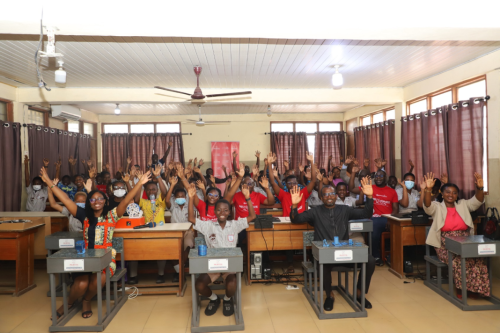
Prudential Life Insurance Ghana donated 100 recycled plastic desks to Gbegbeyise Basic School on December 19, 2025, marking an expansion of corporate involvement in addressing Ghana’s waste crisis through practical solutions that benefit education.
The project, implemented with Academic City University, converts bottles and sachets into classroom furniture, attempting to bridge the gap between environmental responsibility and immediate community needs while raising questions about whether such initiatives can scale enough to make meaningful impact on Ghana’s massive plastic problem.
Ghana generates approximately 840,000 tonnes of plastic waste annually, yet only 9.5 percent reaches recycling facilities according to World Economic Forum data. Recent government reports suggest the situation may be worsening, with 2025 data indicating collection rates could be as low as 5 percent of the estimated 1.1 million tonnes now generated yearly. This discrepancy reflects both increasing plastic consumption and persistent failures in collection infrastructure. The remaining waste clogs drainage systems, pollutes waterways, and creates public health hazards, particularly in urban centers where flooding intensifies during rainy seasons.
The desk project began modestly. Chief Operations Officer Peter Edem Adjei explained that Prudential started with office waste segregation before encouraging staff and agents to bring plastic waste for recycling. This grassroots approach evolved into partnership with Academic City University, where students worked with social enterprise Mckingtorch Africa to manufacture the desks. Academic City developed specialized machinery in collaboration with a United States partner university to convert plastic waste into reusable materials suitable for furniture production.
The 100 desks delivered to Gbegbeyise Basic School address immediate need. School management and teachers described the donation as timely, noting some classrooms previously lacked adequate furniture. Students now have functional seating that should prove more durable than traditional wooden desks in humid coastal environments. The plastic construction resists water damage and insect infestation, potentially reducing long-term replacement costs for schools operating under severe budget constraints.
However, the scale of Ghana’s plastic waste problem dwarfs even ambitious corporate initiatives. If only 5 percent of 1.1 million tonnes gets collected annually, that leaves over one million tonnes entering the environment yearly. Converting this volume into products like school desks would require industrial capacity far exceeding current capabilities. Academic City’s specialized machinery and student labor can produce limited quantities, but expanding production faces bottlenecks in collection logistics, processing capacity, and market demand for recycled products.
Collection infrastructure remains Ghana’s primary obstacle. Plastic waste must travel from homes and commercial areas to sorting facilities, where contamination levels determine recyclability. Food residue on sachets and bottles requires intensive cleaning before processing, driving up costs. Without systematic household separation of waste, contaminated plastic arrives at recycling facilities unsuitable for manufacturing. Metropolitan, Municipal, and District Assemblies lack resources and enforcement capacity to implement effective collection systems, particularly in informal settlements where much plastic waste originates.
Economics complicate recycling viability. Virgin plastic derived from petroleum frequently costs less than recycled alternatives, discouraging manufacturers from purchasing recycled content. Manual labor required for collection and sorting, combined with high energy costs for processing machinery, makes recycled plastic expensive to produce. Prudential’s initiative sidesteps market economics by donating finished products rather than selling recycled material, but this model depends on corporate social responsibility budgets rather than sustainable business fundamentals.
The circular economy framework Ghana launched through United Nations Industrial Development Organization partnership aims to address these systemic issues. The 7 million dollar project funded by Global Environment Facility targets recovery of 93,000 tonnes of plastic waste over five years while training over 2,000 stakeholders in circular economy practices. Initial disbursements to ten small and medium enterprises pilot innovative approaches to waste management, focusing on preventing environmental pollution and creating effective after-use economies for plastics.
Yet policy ambitions repeatedly encounter implementation challenges. Ghana approved its National Plastics Management Policy in 2020, establishing frameworks for comprehensive waste management across product lifecycles. Extended Producer Responsibility schemes that would require manufacturers to fund waste collection and recycling have moved slowly from policy documents to operational programs. Without mandatory producer funding, collection systems remain undercapitalized and inefficient.
Academic City positioned the desk project within its broader Sustain City initiative, which empowers students to tackle environmental challenges through practical engineering solutions. Director of Program Management Tanko Mohammed emphasized that “education and sustainability go hand in hand” when discussing the partnership. This educational dimension matters beyond immediate environmental impact. Students gain experience in circular economy principles, waste processing technologies, and social enterprise operations that could inform future career paths in emerging green industries.
The furniture application demonstrates one pathway for absorbing recycled plastic, but market saturation limits scalability. Ghana’s schools need desks, but demand has ceiling. After equipping classrooms, additional desk production finds diminishing markets. Successful circular economy requires diverse applications, from construction materials to packaging to automotive components. Blowplast’s Tema recycling plant processes polyethylene sachets and bags into garbage bags, pipes, and household plastics, illustrating how multiple product streams create sustainable demand for recycled content.
Corporate social responsibility increasingly incorporates environmental initiatives, but motivations vary. Prudential frames the project through its stated purpose of being partners for every life and protectors for every future, linking insurance industry risk management to climate action. Companies face growing stakeholder pressure to demonstrate sustainability commitments, particularly as consumers and investors scrutinize environmental practices. Whether such initiatives represent genuine transformation or primarily serve public relations objectives depends partly on sustained commitment beyond headline-generating launches.
Waste pickers comprise a critical but vulnerable component of Ghana’s informal recycling sector. Over 2,000 individuals clean beaches, drains, and streets, collecting plastic for sale to recycling centers. These workers typically earn around 2.17 dollars daily according to Green Africa Youth Organization research, below United Nations extreme poverty thresholds. They lack job security, labor rights, and health protections despite performing essential environmental services. Formalizing waste picker contributions through fair wage systems and safety equipment could dramatically improve collection rates while addressing economic inequality.
Technology initiatives attempt to improve waste picker conditions and system efficiency. The Global Plastic Action Partnership collaborates with SAP to create mobile software providing waste pickers with current pricing information for different plastic types. Better price transparency theoretically enables pickers to prioritize materials offering higher returns while helping recyclers secure reliable feedstock supplies. However, technology alone cannot overcome fundamental economic barriers when recycled plastic remains more expensive than virgin alternatives.
International frameworks increasingly recognize plastic pollution as requiring coordinated action. The Intergovernmental Negotiating Committee works toward legally binding instruments on plastic pollution, with National Action Plans emerging as viable implementation mechanisms. Ghana’s participation in these global efforts positions the country to access technical assistance and funding, but effectiveness depends on translating international commitments into domestic enforcement.
The desk donation generated positive media coverage and community appreciation, serving immediate communication objectives. Teachers and students expressed gratitude, describing improved learning environments. Such tangible outcomes matter, particularly for schools operating with inadequate resources. However, measuring ultimate impact requires tracking whether the initiative expands beyond initial donations, whether Academic City scales production capacity, and whether similar partnerships proliferate across other corporations and institutions.
Infrastructure development for plastic waste management requires sustained investment exceeding corporate social responsibility budgets. Government must allocate significant funding for collection vehicles, sorting facilities, washing equipment, and processing machinery. Metropolitan areas need transfer stations where waste aggregates before transport to central recycling plants. Rural communities require adapted solutions given lower waste volumes and longer transport distances. These capital investments compete with numerous development priorities in resource-constrained budgets.
Behavioral change campaigns complement infrastructure improvements. Public education about waste separation, recycling benefits, and environmental impacts shapes consumer practices over time. Schools provide natural venues for cultivating environmental consciousness among young people who influence household behaviors. Community workshops and media campaigns reinforce messages about proper disposal and recycling participation. However, behavioral interventions succeed primarily when convenient infrastructure supports desired actions.
The question persists whether initiatives like Prudential’s desk project represent meaningful environmental progress or marginal contributions to overwhelming challenges. Converting several hundred kilograms of plastic into 100 desks removes that material from potential environmental contamination while providing functional classroom furniture. This constitutes genuine positive impact for Gbegbeyise Basic School students. Yet against annual plastic waste generation exceeding one million tonnes, such projects barely register statistically.
Optimists emphasize that systemic change requires many small initiatives accumulating into larger movements. Corporate engagement raises awareness, demonstrates feasibility, and potentially inspires replication. Pessimists counter that focusing attention on feel-good projects distracts from addressing root causes including excessive packaging, inadequate regulation, and economic structures favoring disposability over durability.
Prudential’s commitment to sustainability includes multiple environmental initiatives beyond plastic recycling. The company has undertaken mangrove restoration in Ada, emphasizing wetland conservation. It promotes electric vehicle adoption internally, reducing carbon emissions from business operations. These complementary efforts suggest broader strategic thinking about corporate environmental responsibility rather than isolated projects seeking publicity.
Academic City’s role deserves attention beyond this specific partnership. Universities possess research capabilities, technical expertise, and student energy that position them as innovation hubs for sustainability solutions. Sustain City initiative demonstrates how higher education institutions can move beyond traditional academic functions into practical problem-solving that benefits communities while educating future professionals. Replicating such models across Ghana’s university system could generate diverse approaches to environmental challenges.
The December timing positions the initiative within year-end giving patterns when corporations finalize social responsibility budgets and seek positive community engagement. Whether commitments extend into subsequent years determines whether projects represent one-time donations or sustained programs. Long-term partnerships between corporations, universities, and schools could create reliable streams of recycled products while continuously improving production processes and expanding applications.
Private sector innovation offers advantages including agility, technological sophistication, and market responsiveness that government programs sometimes lack. However, comprehensive solutions to plastic waste require government leadership in establishing regulatory frameworks, enforcing environmental standards, and coordinating stakeholders. Public-private partnerships combining corporate resources with government authority potentially achieve more than either sector manages independently.
The fundamental tension remains between celebration of positive initiatives and recognition of their limitations against massive systemic problems. Gbegbeyise Basic School students benefit materially from new desks. Prudential demonstrates corporate citizenship. Academic City advances educational mission while developing practical engineering solutions. These outcomes merit acknowledgment. Simultaneously, Ghana’s plastic waste crisis requires interventions at scales these projects barely approach, involving policy reforms, infrastructure investments, and economic restructuring that transcend corporate philanthropy.

