

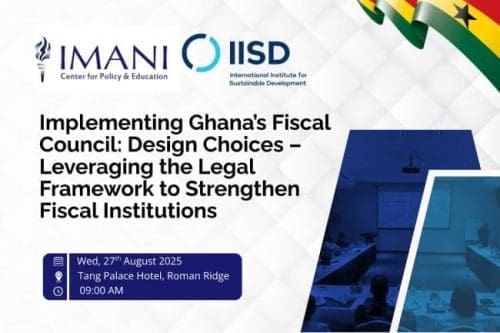
Government officials, lawmakers and development partners will meet Wednesday in Accra to design Ghana’s new Fiscal Council, an independent body tasked with monitoring the country’s financial management and debt levels.
The roundtable at Tang Palace Hotel brings together representatives from Parliament, civil society organizations and researchers to discuss implementation of the council established under the Public Financial Management Amendment Act passed earlier this year.
The International Institute for Sustainable Development and IMANI Center for Policy & Education are organizing the session as Ghana works to strengthen fiscal discipline following years of economic challenges. The new legislation sets ambitious targets including a fiscal surplus ceiling of 1.5 percent of GDP and reducing public debt to 45 percent of GDP by 2034.
Ghana’s recent history of debt distress and macroeconomic instability has highlighted the need for stronger fiscal oversight. The country completed a debt restructuring program earlier this year after seeking relief from international creditors amid soaring borrowing costs.
The proposed Fiscal Council aims to provide evidence-based budget advice while increasing transparency in government spending decisions. Organizers say an independent institution could help restore investor confidence by anchoring market expectations around sustainable fiscal policies.
A new report will be presented during Wednesday’s meeting outlining recommendations for the council’s structure and operations. The document emphasizes the importance of real-time access to fiscal data and transparent reporting mechanisms to ensure effective oversight.
The discussion will explore how the Ministry of Finance and Parliament can integrate the council’s work into existing budget processes. Development partners are expected to outline potential support for establishing the institution and building its analytical capabilities.
Similar fiscal councils operate in other countries as independent watchdogs monitoring government spending and debt sustainability. These institutions typically publish regular assessments of budget policies and provide public analysis of long-term fiscal trends.
The timing reflects Ghana’s broader efforts to rebuild economic stability under President John Mahama’s administration. The government has prioritized restoring macroeconomic balance while maintaining spending on education, health and infrastructure development.
Participants will examine how the council can balance fiscal discipline with development priorities in a country where public investment remains crucial for growth. The institution’s credibility will depend on its independence from political influence and access to comprehensive government financial data.
The August 27 roundtable represents a key step in operationalizing legislation that could reshape Ghana’s approach to fiscal management. The council’s effectiveness will ultimately depend on its ability to influence budget decisions while maintaining public trust in its analysis.

