

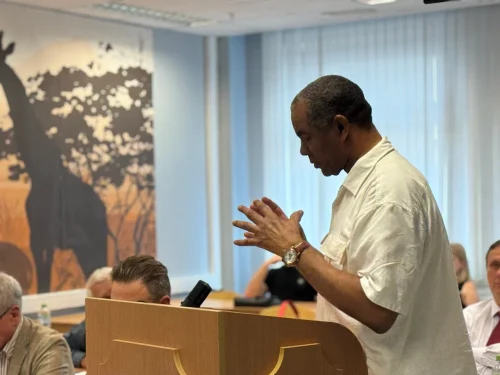
African scholars, politicians and diplomats gathered at Lomonosov Moscow State University on May 22 to formally recast Africa as a sovereign force shaping the world’s emerging multipolar order, with Zambia’s rejection of a US minerals deal surfacing as a live illustration of the shift underway.
The Strategic Session on “The Role and Place of Africa in the Formation of a Polycentric System of International Relations” was convened by the Russian-African Club of Lomonosov Moscow State University (MSU), the Public Diplomacy Foundation, and the Globus-21st Century Research and Educational Center. It formed part of the VIII International Scientific and Practical Conference on “Current Problems of Global Research: Megatrends of Global Development.”
Participants arrived with one central argument: that Africa has moved from being an object of foreign decisions to a continent writing its own terms of engagement.
That argument found an immediate real-world reference in Zambia. Richard Silumbe, a Zambian presidential candidate and president of the Leadership Movement political party, told the session that Zambia’s president had refused to sign a deal that would have handed Washington preferential access to the country’s natural resources in exchange for health sector assistance. His account aligned with public statements made earlier this month by Zambia’s Foreign Minister Mulambo Haimbe, who confirmed negotiations with the United States were stalled over what he described as “unacceptable” demands, including data-sharing requirements and preferential treatment for American companies in the country’s minerals sector.
Silumbe framed the refusal as a sign of broader continental self-assertion. He called on Russia to deepen cooperation with Zambia in energy and peaceful nuclear research as an alternative path to reducing the country’s reliance on hydropower.
Kinfu Zenebe, president of the Union of African Diasporas in Russia and an Ethiopian expert, pointed to Africa’s demographic weight as the structural foundation of its emerging influence. With more than 900 million Africans under 35 years old, representing over 60 percent of the continent’s population, the continent carries generational leverage that no external power can ignore indefinitely. He identified Western media dominance, healthcare gaps and youth unemployment as the three sharpest obstacles to Africa fully exercising that leverage.
Louis Gowand, Chairman of the Commission for Work with African Diasporas at the Russian-African Club of MSU, drew the political conclusion directly. “The African continent is not an object, but a key and sovereign actor in global politics,” he said.
The session also addressed the security architecture underpinning Russia’s African engagement. Daniel Sawadogo, head of the MSU Russian-African Club branch in Burkina Faso and former cultural attaché of the Embassy of Burkina Faso in Russia, cited events in Mali in April 2026 as evidence that the Alliance of Sahel States (AES), comprising Mali, Burkina Faso and Niger, had withstood a coordinated assault with the support of Russia’s Africa Corps. Malian parliamentarian Aliou Touankara credited Russia’s approach to the security partnership as one of non-interference in governance while providing material support against armed groups.
The Faculty of Global Studies Dean, Professor Ilya Vyacheslavovich Ilyin, opened proceedings by noting that students at the faculty already study Swahili, with additional African languages planned. He proposed naming a newly designed auditorium after Amadou-Mahtar M’Bow, the Senegalese scholar and former Director-General of the United Nations Educational, Scientific and Cultural Organization (UNESCO), who received an honorary doctorate from MSU in 1977.
Executive Secretary of the Russian-African Club Alexander Fedorovich Berdnikov confirmed that all Club events this year run under the banner of the Third Russia-Africa Partnership Summit, scheduled for Moscow in October 2026. A new cooperation plan covering the period through 2029 is expected to be formally adopted at that summit.

