

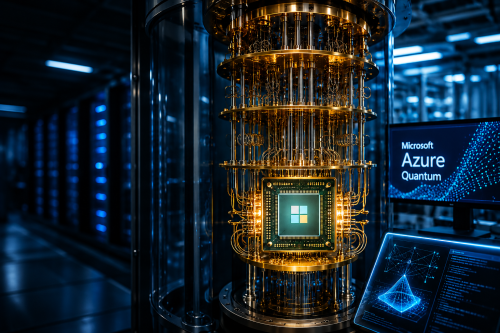
Microsoft unveiled a new quantum computing chip on Tuesday that it says is 1,000 times more reliable than its predecessor, announcing at the same time that the company now expects to have a commercially viable quantum machine ready by 2029, six years ahead of its previous target.
The chip, called Majorana 2, was presented at Microsoft’s Build developer conference in San Francisco. The company had originally planned to achieve practical quantum computing by 2035, but the latest results have dramatically shrunk that timeframe.
At the centre of the announcement is a breakthrough in qubit stability. The original Majorana 1 chip achieved qubit lifetimes of five to ten seconds, while Majorana 2 has expanded this to at least 20 seconds per qubit, with some lasting as long as a minute. Microsoft likened the improvement to the difference between a phone that needs daily charging and one that holds its charge for years.
The company also disclosed how the chip was built. With the help of agentic AI, consisting of autonomous AI agents guided by human scientists, Microsoft finally overcame significant manufacturing tradeoffs and transitioned its chip from traditional aluminium to a lead superconductor materials stack. The semiconductor active region was also updated to a combination of indium arsenide and indium arsenide antimonide.
Despite the enthusiasm, the path from laboratory chip to commercial machine remains steep. Such a machine would need millions of qubits. The chip Microsoft demonstrated has 12.
Scientific scrutiny is also part of the picture. The topological approach has burned Microsoft before. The company had to withdraw a 2018 paper in the journal Nature that claimed evidence of the Majorana particle. It shipped its first Majorana chip in 2025 to considerable doubt from experts unconvinced by its claims. The Majorana 2 findings have not yet undergone peer review, and independent scientists have called for further verification before drawing firm conclusions.
Cautious optimism exists within the scientific community. Physics professor Paul Stevenson of the University of Surrey said that if the research holds up, Microsoft would leap from having no production quantum computer to becoming a serious player in the race to build the next generation of fault-tolerant machines.
Microsoft’s quantum team says it is overcoming key barriers in reliability, speed, and size that have limited the application of quantum computing to real-life scenarios, with potential applications in materials science, chemistry, environmental modelling, and pharmaceutical development, though experts caution those outcomes remain long-term prospects.

