

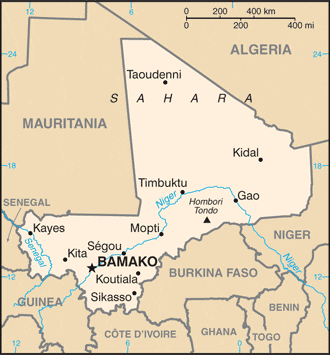
A wave of coordinated attacks that struck Mali on Saturday, April 25, has sharpened concerns about the country’s investment climate, with risks now extending well beyond its gold mines to transport networks, telecoms infrastructure, and an emerging digital economy.
On April 25, a series of coordinated attacks occurred across multiple locations in Mali. The Azawad Liberation Front claimed control of Kidal and parts of Gao, while gunfire was simultaneously reported in Sévaré, Mopti, and the capital Bamako. The Malian military confirmed it was clashing with unidentified armed terrorist groups that had targeted certain locations and barracks in the capital and the interior. Security sources cited by Reuters indicated that Jama’at Nusrat al-Islam wal-Muslimin (JNIM), an al-Qaeda-linked militant coalition, was also involved.
The African Union Commission Chairman strongly condemned the attacks, warning that they risk exposing civilian populations to significant harm and threaten peace, security, and stability in Mali.
The April 25 violence follows a pattern of escalating economic targeting. In January 2026, suspected jihadists attacked the Morila gold mine in Mali’s southern Sikasso region, burning equipment and taking seven employees hostage before releasing them all the following evening. The Morila mine operates under a partnership between United States-based Flagship Gold and Mali’s state mining enterprise, with estimated gold reserves of 2.5 million ounces.
Gold Sector Under Pressure
Mali is Africa’s third-largest gold producer, and its position creates revenue dependency that influences government security prioritisation. However, state capacity to protect remote mining installations remains constrained by competing security demands and limited military resources.
Al-Qaeda-linked militant groups across the Sahel increasingly recognise that attacking production infrastructure generates greater long-term impact than targeting personnel alone, representing a tactical shift toward systematic economic disruption. For investors, this evolution means that risk assessments must now account for sustained infrastructure targeting rather than isolated incidents.
The attacks come as Mali’s military government has moved to tighten control over the mining sector through revised rules aimed at boosting state participation. The combination of regulatory overhaul and escalating insecurity is creating a high-risk environment in which capital allocation decisions are being made more cautiously and, in some cases, deferred.
Transport, Telecoms and Digital Services Exposed
As a landlocked country, Mali depends heavily on regional corridors to move gold and other goods to export markets. Disruptions linked to insecurity quickly translate into higher logistics costs, delays at borders, and added pressure on import-dependent sectors.
The impact is not limited to traditional industries. Telecom operators and fintech providers that have been expanding data services and mobile money platforms face growing vulnerability as infrastructure such as towers and fibre networks either becomes a target or operates in increasingly unstable regions. That could slow momentum in digital adoption and financial inclusion, areas widely identified as key to long-term economic diversification across the Sahel.
Regional Spillover and Sovereign Risk
Cross-border coordination among militant networks complicates threat assessment across multiple jurisdictions, and intelligence sharing between Mali, Niger, and Burkina Faso remains limited, creating information gaps that affect private sector security planning.
Rising insecurity typically feeds into higher insurance premiums, tighter lending conditions, and elevated sovereign risk perceptions. For Mali, that translates into increased borrowing costs and reduced appetite from international investors, compounding fiscal pressures already tied to lower export revenues during periods of disruption.
Government travel advisories from Britain, France, and the United States trigger risk management protocols that may require institutional investors to divest or suspend commitments regardless of specific project risk assessments.
The military government’s push to capture more value from natural resources and expand digital infrastructure reflects a coherent economic strategy. The renewed and widespread violence of April 25, however, underscores a central constraint: that strategy may struggle to gain traction without sustained improvements in security. For now, investors are likely to demand higher returns to compensate for risk, slow new commitments, and intensify scrutiny of existing operations across the country.

