

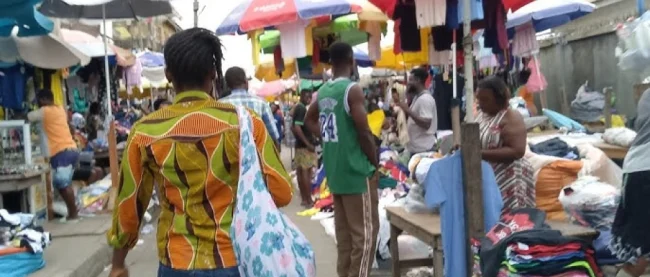
One year after a fire swept through sections of Kantamanto Market, traders say the emphasis has shifted from mourning losses to rebuilding structures, strengthening safety systems, and restoring confidence. Business activity remains below pre-fire levels despite resumption of trading at West Africa’s largest hub for second hand clothing and household items.
The blaze destroyed hundreds of stalls and goods valued at millions of Ghana cedis, displacing thousands of traders, the majority of them women, and disrupting supply chains nationwide. Chairman of the Kantamanto Used Clothes Association, Mr Micheal Oppong, said in an interview that although trading had resumed, full recovery was still a work in progress.
“We have been able to rebuild with support from benevolent individuals, banks and NGOs, and trading has resumed,” he stated. “But the market has not yet regained the energy and volumes we used to see before the fire.”
Rather than dwell solely on reduced sales, Mr Oppong said market leaders were prioritising long term safety and order. Enhanced security arrangements had been introduced in collaboration with state agencies to prevent a recurrence of the disaster. Fire Service personnel now operate on a three shift system at the market, supported by the Police, National Security, and internal security teams.
Trading activities are halted at 1800 hours daily to allow cleaners to work, after which the market is handed over to security personnel for the night. The Association has intensified efforts to eliminate illegal electrical connections, often cited as a major cause of market fires, warning that offenders would face sanctions.
Despite progress, Mr Oppong acknowledged that not all traders had been able to return. Many lacked the capital to restart after losing everything in the fire. “Those who had support from family or friends are back, but others are still struggling, especially women. We are appealing for continued assistance,” he noted.
The current security arrangement is being financed from internally mobilised funds, which Mr Oppong described as unsustainable in the long term. However, he expressed optimism about future plans, revealing that proposals for an ultramodern market had been submitted to the Presidency. No trader will lose his or her stall under the proposed redevelopment, he assured.
The Ghana National Fire Service has trained traders in fire prevention and the use of extinguishers, with about 1,000 extinguishers distributed across the market and 170 mounted at strategic locations. Mr Oppong admitted, however, that insuring goods remained difficult, as insurers considered the market high risk due to its predominantly wooden structures.
He renewed calls on President John Dramani Mahama and former Vice President Dr Mahamudu Bawumia to fulfil pledges to install closed circuit television (CCTV) cameras to enhance security. The technology could help monitor the sprawling market and deter criminal activity while providing evidence in case of future incidents.
While safety reforms were underway, some traders blamed slow recovery on rising input costs and structural challenges. Mr Godfred Afotey, Chairman of the Bright Morning Star Association, said high prices of second hand clothing bales were affecting sales.
“Even though import duties have reduced, middlemen still control the supply chain, making bales expensive and forcing traders to sell at higher prices,” he said. He also pointed to congestion caused by traders operating on streets and railway lines, which diverted customers from the main market.
Mr Afotey called on the Accra Metropolitan Assembly to enforce regulations and relocate roadside traders back into designated market spaces. The encroachment onto surrounding areas has created unfair competition and safety hazards while undermining efforts to restore order within the formal market structure.
Personal losses from the fire remain fresh for many. Mrs Philippa Adusei, a market queen and trader in household items for over two decades, said she lost goods worth nearly 100,000 Ghana cedis and had only managed to restart with help from relatives and friends. Her experience reflects the financial devastation faced by traders who lacked insurance or emergency savings.
Another trader, Madam Sophia Akua Pokua Amoah, said business was still slow because many customers believed the market had not fully reopened. She said she lost about 50,000 Ghana cedis in goods and was surviving by selling items obtained on credit, adding that persistent power outages were worsening working conditions.
Despite the challenges, traders expressed cautious hope that sustained support, better infrastructure, and improved safety measures would gradually restore Kantamanto’s role as a vibrant commercial hub. The market’s recovery has broader economic implications given its position as a major employment source and distribution center for affordable clothing across West Africa.
The fire highlighted longstanding infrastructure deficits in Ghana’s informal trading sectors, where wooden structures, inadequate fire suppression systems, and limited access to formal credit create vulnerability. How Kantamanto rebuilds could set precedents for modernizing other major markets facing similar risks.

