

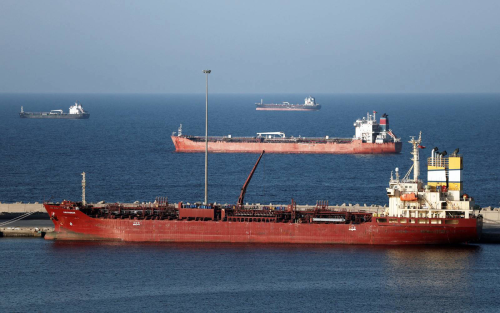
Iran’s parliament is preparing legislation that would formally require vessels to pay transit fees to pass through the Strait of Hormuz, in a move that directly challenges the international legal framework governing freedom of navigation.
The Iranian parliament is working on a draft bill that would impose a fee on vessels seeking safe passage through the Strait of Hormuz, according to the semi-official Fars news agency. Fars, citing an unnamed lawmaker, said the plan would be finalised next week, and would legally recognise Iran’s oversight of Hormuz, a vital conduit connecting some of the world’s largest oil and gas producers in the Persian Gulf with the wider world.
The Fars and Tasnim news agencies, both close to Iran’s paramilitary Revolutionary Guard, quoted lawmaker Mohammadreza Rezaei Kouchi as saying that parliament was working to formalise the process of charging fees to let ships pass. “We provide its security, and it is natural that ships and oil tankers should pay such fees,” he was quoted as saying.
The narrow waterway has been all but closed since United States and Israeli strikes on Iran began almost a month ago, with only a trickle of ships making their way through in the intervening weeks, most of them with Iranian or Chinese connections and a handful that have secured safe passage from the Islamic Revolutionary Guard Corps (IRGC). Tehran’s legislation would formalise a unilateral arrangement already widely reported by the shipping industry, with payments of as much as $2 million reportedly being sought from individual vessels.
The proposal raises complex legal questions under international maritime law, specifically under the United Nations Convention on the Law of the Sea (UNCLOS), which grants all nations the right of transit passage through international straits used for navigation. Iran is a signatory to UNCLOS, and any attempt to impose fees on transit passage would likely face legal challenge.
Karen Young, senior research scholar at Columbia University’s Center on Global Energy Policy, said it was “very clear” Iran would not be able to operate a toll booth through the Strait of Hormuz, noting that Gulf Cooperation Council (GCC) states including the United Arab Emirates, Saudi Arabia, and Oman are not going to accept or tolerate it.
The secretary-general of the Gulf Cooperation Council accused Iran of already charging fees for ships to safely transit the Strait, becoming the first top official to make that accusation publicly. Industry experts say some ships are paying in Chinese yuan to pass through the waterway, through which 20 percent of all traded oil and natural gas is transported in peacetime.
The disruption of flows through Hormuz has resulted in forced shut-ins of Persian Gulf oil production, while refineries in the area have also been damaged in the war. Oil prices have surged as a result, with global benchmark Brent topping $114 a barrel earlier this week.
The draft legislation emerges as diplomatic efforts to end the conflict appeared to stall. Tehran dismissed claims of direct talks with Washington as inaccurate, with a Foreign Ministry spokesman saying no one could trust United States diplomacy given Washington’s role in starting the conflict. Iran and the United States hardened their positions on Thursday as a diplomatic push for a ceasefire appeared to falter, with Washington preparing for the arrival of United States troops in the region that could be used on the ground.
If enacted, the toll law would mark one of the most consequential challenges to international maritime order in the modern era, with implications that extend well beyond the current conflict.

