

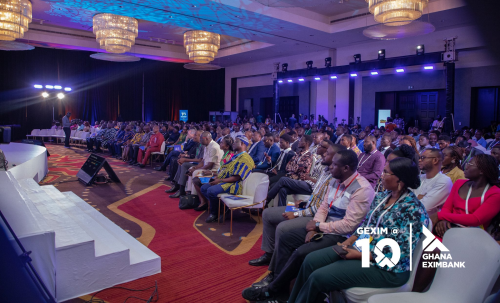
As Ghana’s Export-Import Bank (GEXIM) concludes its landmark 10th anniversary international conference in Accra, a model emerging from India’s own export development experience is drawing attention as a potential blueprint for the next phase of Ghana’s industrial transformation.
T.D. Sivakumar, Chief General Manager of the Export-Import Bank of India, outlined to visiting African and Pacific journalists how the Indian institution has moved well beyond its original mandate of trade financing to become a full ecosystem builder for micro, small and medium enterprises (MSMEs), women-led businesses and rural industries.
The shift, he explained, rests on a simple but often neglected principle: credit alone does not create competitive exporters.
In one illustration, the bank supported apricot farmers in a dry, low-activity region of northern India by combining cold storage infrastructure, post-harvest tools and technical training for around 250 farmers, turning an underperforming agricultural zone into a functioning export cluster. In the Karnataka town of Channapatna, known for eco-friendly wooden toys, the bank paired machinery and equipment grants with skills training delivered in partnership with the National Institute of Fashion Technology to raise product quality to international standards. Industrial firms in Kolhapur received financing to adopt 3D scanning and casting simulation technology, improving their global competitiveness.
Women’s economic inclusion is embedded directly into the model. In Madhya Pradesh, the bank financed equipment and training for a batik printing cluster run predominantly by women. Separately, 30 women were trained as auto mechanics through a partnership with DBM India, creating pathways into higher-income technical work.
The approach extends to social and environmental investment. The bank has contributed to cancer care equipment at the Tata Memorial Hospital and has partnered with a technology-enabled environmental foundation to plant nearly 60,000 trees across India, generating an estimated carbon offset of about 35,000 tonnes annually.
The parallels with GEXIM’s own evolving direction are clear and timely.
GEXIM Chief Executive Officer Sylvester Adinam Mensah, speaking at the bank’s two-day anniversary conference in Accra, stressed that finance by itself is not enough and that Ghanaian businesses need a complete support system, not just a single facility. He outlined a shift toward a more targeted, results-oriented approach, with emphasis on key sectors, MSME growth and expanded trade finance instruments.
The anniversary celebrations, which concluded on Thursday, included the signing of memoranda of understanding with six Ghanaian firms, a three-day Agrotech Fair, capacity-building programmes for small and medium enterprises, and exhibitions of Made-in-Ghana products.
Vice President Jane Naana Opoku-Agyemang, addressing the conference, called on GEXIM to intensify support for value addition, industrial production and small businesses, noting that shifting global trade dynamics demand deliberate policies that prioritise value addition and enhance the competitiveness of local industries.
The conference also deliberated on unlocking MSME export potential through guarantees and risk-sharing instruments, leveraging digital and artificial intelligence solutions in export finance, and sector-specific opportunities in garments, poultry and agro-processing.
GEXIM’s mandate under Act 911 of 2016, which established it to help Ghana move from raw material exports to value-added products, maps directly onto the integrated approach Sivakumar described. The gap that both institutions are working to close is the same: the space between a business that can access credit and one that can actually compete in global markets.
With the African Continental Free Trade Area (AfCFTA) opening a combined market of more than 1.4 billion people, that gap has never been more consequential for Ghana’s industrial future.

