

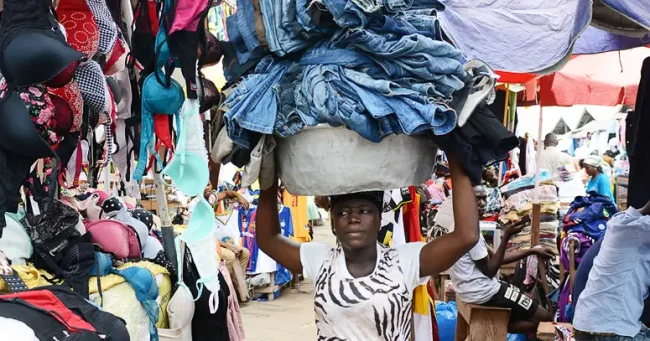
Traders in Accra’s busiest markets are being crushed by unofficial goodwill payments reaching as high as GH¢500,000, compounded by runaway rent inflation and pricing linked to the dollar, with the combined burden eroding profit margins and locking out new entrepreneurs.
An investigation by the Business and Financial Times (B&FT) found the practice deeply entrenched at Makola, Kantamanto and Madina markets, operating almost entirely outside official records with no receipts issued and no revenue declared to tax authorities.
Goodwill in these market centres refers to undocumented upfront payments demanded by landlords, agents or facility managers before a trader can occupy a stall. The charges are framed as recognition of an established location’s commercial value, but traders say they are arbitrary and function primarily as steep barriers to entry.
“We all pay goodwill, and it is very expensive,” said Raman’s Madam, a shop owner at the Makola SSNIT Mall, who disclosed paying GH¢500,000 for her current location and spreading the balance at GH¢500 a month on top of her official rent.
At Kantamanto, agents enforce the system through unofficial notebooks, recording cash transactions with no receipts or tax documentation. Traders who refuse to pay risk removal when their lease ends, with landlords aware that replacement tenants stand ready.
One trader identified as Rich said his monthly rent climbed from GH¢500 to GH¢6,000 over 15 years, a rise of 1,100 percent, before his landlord restructured his lease and demanded an additional non-refundable GH¢50,000 goodwill payment simply for the right to keep the space he had occupied for a decade.
Nana Yaw, a hair products dealer, was forced to close one of his two Makola stalls after his annual rent reached GH¢70,000, while Collins, who has traded at Makola for 20 years, said his landlord adds between GH¢1,500 and GH¢2,000 to his rent every year, with his current annual bill standing at approximately GH¢67,000 before taxes and levies.
Traders also accused landlords of adjusting rents upward whenever the cedi weakens against the dollar but never reversing them when the currency recovers.
The Accra Metropolitan Assembly (AMA) denied any involvement in the practice. AMA spokesperson Gilbert Ankrah said the assembly has no revenue stream labelled goodwill in its books and does not collect such fees from shop occupants. He acknowledged, however, that some AMA tenants sublet their stalls to third parties at inflated rates and may be imposing their own goodwill demands.
At Madina market, the dominant problem was identified as inflated subletting by agents and middlemen rather than direct goodwill claims, with some traders paying nearly double the assembly’s official rate for identical spaces.
The Rent Control Department (RCD) has failed to act despite awareness of the situation. Traders say its complaint-driven model is ineffective because filing a formal complaint risks immediate eviction, and landlords always have replacement tenants ready to move in.
Investigators suggest the Ghana Revenue Authority (GRA) and the Bureau of National Investigations (BNI) must work alongside Municipal Assemblies to dismantle the informal cash collection system, enforce the legal six-month cap on rent advances and eliminate middlemen from stall allocation to restore fairness to Accra’s retail markets.

