

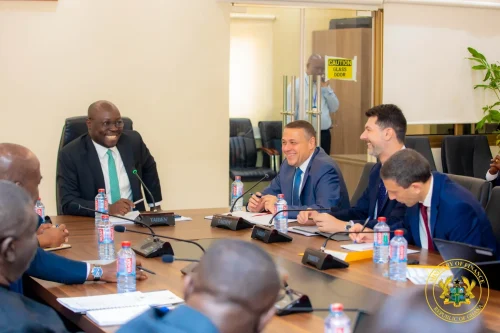
Ghana’s international reserves continue outperforming benchmarks set under its International Monetary Fund-supported programme, backed by robust exports, fiscal discipline, and improving investor confidence, the Fund said following a staff visit to Accra.
The IMF reached a staff-level agreement with Ghana on Thursday for the fifth review of the country’s economic programme, potentially unlocking approximately $385 million in additional support. The announcement highlighted Ghana’s stronger-than-expected economic performance across multiple indicators.
“International reserves accumulation continues to exceed the ECF-supported program targets, while the cedi appreciated markedly in the first half of the year,” the IMF stated, noting that the external sector had strengthened on higher gold and cocoa exports.
Ghana’s inflation rate dropped to 9.4% in September, marking the first single-digit reading in four years. The achievement represents a dramatic turnaround from December 2022 when inflation peaked at 54.1%, providing vindication for tight monetary policy and improved food supplies that helped ease price pressures.
The cedi gained nearly 50% against the US dollar in 2025, making it the strongest performing currency globally this year, according to Bloomberg data. The currency’s remarkable recovery, from approximately 15 cedis per dollar at the start of the year to around 10.3 by mid-year, has contributed significantly to inflation’s decline and improved economic sentiment.
Services and agricultural output lifted economic growth beyond expectations in the first half of 2025, the Fund noted. The IMF projects this positive momentum will continue into 2026, forecasting growth at 4.8% with inflation remaining within the Bank of Ghana’s target band of 8±2%.
“Macroeconomic stabilization is taking root,” the IMF said, emphasizing that prudent fiscal management and ongoing debt restructuring remain key to sustaining the recovery. The assessment suggests Ghana’s economic turnaround, while still fragile, has begun establishing firmer foundations.
With inflation falling toward its target band, the Bank of Ghana has embarked on an easing cycle, cutting the policy rate by a cumulative 650 basis points to 21.5%. The aggressive rate cuts signal central bank confidence that inflationary pressures have genuinely subsided rather than temporarily paused.
Once the IMF Executive Board approves the staff-level agreement, Ghana will gain access to about $385 million, bringing total disbursements under the $3.2 billion Extended Credit Facility to around $2.8 billion since its approval in May 2023.
The programme has provided crucial support through Ghana’s comprehensive debt restructuring, which included substantial haircuts on eurobond principal and rescheduling of both local currency obligations and bilateral official-sector debt. These measures reduced the government’s debt burden from 93% of GDP in 2022 to lower levels, easing pressure on public finances.
Yet challenges remain despite the improved outlook. Ghana must maintain fiscal discipline ahead of future electoral cycles, continue servicing restructured debt obligations, and ensure that reserve accumulation doesn’t mask underlying vulnerabilities in the economy’s productive capacity.
The cedi’s appreciation, while beneficial for inflation control and import costs, has raised concerns among exporters who find their products less competitive in international markets. Some economists question whether the currency’s strength is sustainable or partially reflects temporary factors that could reverse.
There’s also the matter of translating macroeconomic stability into tangible improvements for ordinary Ghanaians. While single-digit inflation represents significant progress, many citizens still struggle with high living costs accumulated during the crisis years. The real test will be whether economic gains translate into job creation and income growth.
The IMF’s positive assessment carries weight because the Fund has been intimately involved in Ghana’s stabilization efforts. Its endorsement suggests the reform programme is delivering measurable results, not just managing appearances. The consistent reserve accumulation above targets particularly indicates genuine improvement in Ghana’s external position rather than accounting adjustments.
For policymakers, the challenge now shifts from crisis management to consolidating gains. The 4.8% growth projection for 2026, while respectable, remains modest for an economy seeking to create jobs for a rapidly growing population. Sustaining reform momentum without the urgency of immediate crisis will require continued political will.
The staff-level agreement awaits formal approval by the IMF Executive Board, typically a procedural step following successful negotiations. Assuming approval proceeds as expected, Ghana will have accessed the vast majority of the $3.2 billion facility, with reviews continuing through the programme’s completion.
What’s clear from the IMF’s statement is that Ghana’s economic management has exceeded expectations during a critical stabilization period. Whether this translates into durable prosperity depends on maintaining discipline while expanding productive capacity, a balancing act that has challenged many emerging economies attempting similar transitions.

