

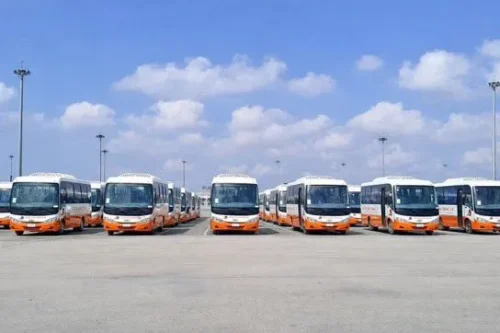
Ghana’s purchase of 300 diesel buses this week risks undermining its Paris Agreement commitments and deterring climate finance at a pivotal moment for green investment mobilisation.
The first batch of 100 Isuzu-manufactured 29-seater buses has arrived for state operators Metro Mass Transit (MMT) and the State Transport Corporation (STC), with two further deliveries of 100 each scheduled for August and November. The procurement is designed to ease commuter pressure on high-traffic corridors. But it arrives as Ghana actively pursues international funding for its clean energy transition.
The country’s updated Nationally Determined Contributions (NDCs) under the Paris Agreement identify electric mobility as a primary pathway for cutting transport emissions, improving urban air quality and reducing the health burden of pollution. The National Energy Transition Plan (NETP), covering 2022 to 2070, places transport sector reform at the centre of the country’s net-zero strategy.
Procuring 300 internal combustion engine (ICE) buses at this scale sends a contradictory signal to the institutions that finance those commitments. Climate finance partners assess government credibility partly through alignment between stated climate goals and actual public spending decisions. Buses that will remain in operation for 10 to 15 years are precisely the category of asset those assessments scrutinise.
“The credibility gap is real,” said Shika Akpaloo, Senior Project Officer at the Centre for Extractives and Development, Africa (CEDA).
She argued that credibility requires more than acknowledging the tension between immediate service delivery and long-term decarbonisation. It demands active management, including a transparent assessment of electric vehicle (EV) alternatives before committing to fossil fuel assets at scale. That assessment does not appear to have preceded this procurement.
The concern extends to the private sector. When the state buys at scale, it shapes the commercial calculus for investors deciding whether to finance EV charging infrastructure, local bus assembly capacity or battery supply chains in Ghana. A sustained government preference for diesel signals limited near-term demand for the ecosystem that electric mobility requires to grow.
Ghana’s EV policy, introduced in 2023, targets 35 percent EV penetration in new vehicle sales and 60 percent electrification of the government fleet by 2035. Buses introduced now will still be in service well past that deadline, competing for fiscal resources and institutional focus with the EV investments the policy envisions.
The Ministry of Energy and Green Transition has defended the procurement as a necessary short-term response to urgent commuter demand, noting that the energy transition is envisioned over a long horizon. Officials argue that modern fossil fuel assets, balanced against investments in renewable energy, can converge toward net-zero emissions over time.
That argument does not resolve the sequencing problem. Kenya, Rwanda and India have each demonstrated that public transport electrification can advance rapidly when procurement policy and targeted financing align. For Ghana, the central question is no longer whether the transition is desirable. It is whether the decisions being made today are building or quietly eroding the foundation for it.

