

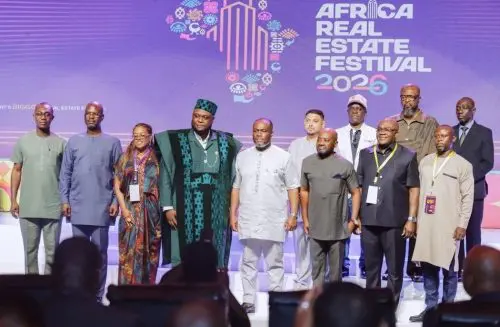
Ghana’s Minister for Works, Housing and Water Resources, Kenneth Gilbert Adjei, used Saturday’s inaugural Africa Real Estate Festival (AREF) 2026 in Accra to announce a sweeping package of housing sector reforms, positioning the country as a continental benchmark for affordable and sustainable urban development.
Addressing 1,500 delegates at the Accra Polo Club on April 19, 2026, under the theme “Innovation Meets Identity: Designing Africa’s Next Living Experience,” the minister outlined reforms spanning land administration, rental regulation, housing finance, and green construction, urging the private sector to take the lead.
“Real estate is about the spaces where people live, work, and connect,” Adjei said. “It influences safety, dignity, productivity, and social cohesion, while also reflecting our cultural identity. In essence, real estate is about place, not just property.”
With the Ghana Statistical Service recording that the private sector currently delivers nearly 90 percent of the country’s housing supply, the minister was direct about the limits of government-led delivery. He called on private developers to scale investment, adopt innovative delivery models, and align with national housing priorities.
The reforms announced include the repositioning of the National Affordable Housing Programme to support large-scale, mixed-income housing through public-private partnerships, as well as a District Housing Programme designed to decentralise delivery so that every district contributes to reducing the national housing deficit.
Adjei confirmed that the Rent Act is under review, with proposed changes to strengthen tenant protections and create a more stable rental market. In partnership with the Lands Commission, the government is also advancing digital land administration reforms to improve title security and cut acquisition delays.
Additional measures include the promotion of local building materials and green construction methods to lower costs and reduce carbon emissions, and new housing finance solutions being developed with financial institutions to widen access to mortgages and long-term credit.
At the opening of the two-day event, AREF founder and Chief Executive Officer (CEO) Desmond Kwesi Oteng challenged the 1,500 delegates to reclaim Africa’s urban narrative. He argued that for too long, critical conversations about African land and real estate had taken place in boardrooms in London, Dubai, and the United States, and that AREF’s convening on African soil marked an end to what he called “narrative outsourcing.”
The Real Estate Agency Council (REAC) used the platform to reinforce compliance requirements, warning practitioners against cash transactions, which are prohibited under the Real Estate Agency Act, 2020 (Act 1027), a measure intended to eliminate fraud and money laundering in the sector.
Headline sponsor Nilex Properties offered a practical demonstration of what homegrown ambition can achieve. The company’s legal and corporate affairs director, Alex Kofi Osei-Owusu, detailed the firm’s 19-storey oceanfront development, which paired technical expertise from Mumbai with a dedicated Ghanaian architecture team. “We want to work with local architects,” he said.
Industry firm Goldkey Properties was formally recognised at the event as a driver of Grade-A standards in the Ghanaian market.
Organisers said the festival will produce the AREF Report 2026, a data-driven publication on real estate trends across the continent, and that AREF plans to expand into a continent-wide circuit beyond this inaugural edition.

