

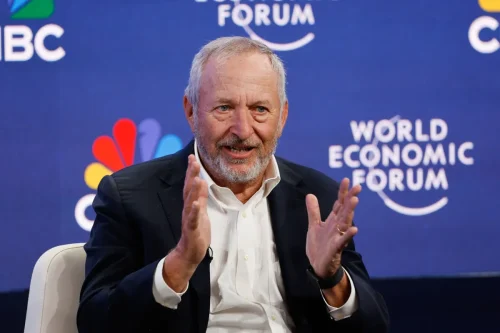
Larry Summers, the former United States Treasury Secretary and one-time president of Harvard University, announced on Wednesday that he will retire from his Harvard professorship at the end of the current academic year, ending a five-decade association with the institution under the shadow of his documented ties to convicted sex offender Jeffrey Epstein.
“I have made the difficult decision to retire from my Harvard professorship at the end of this academic year,” Summers said in a statement, adding that he looks forward to continuing research and commentary on global economic issues as a retired professor.
Harvard Kennedy School Dean Jeremy Weinstein formally accepted Summers’ resignation as co-director of the Mossavar-Rahmani Center for Business and Government, with the university confirming he will remain on leave until his retirement takes effect. He will not resume teaching or take on new student advisees ahead of his departure.
Emails released under the Epstein Files Transparency Act showed the two men communicating as recently as 2018, years after Epstein pleaded guilty in 2008 to state charges involving prostitution with a minor, and just one year before his 2019 arrest on federal sex trafficking charges. In one email, Epstein referred to himself as Summers’ “pretty good wing man,” with Summers subsequently asking Epstein for advice about a woman he had recently met.
Summers flew at least four times on Epstein’s private aircraft, according to flight records made public during litigation, and was the top official at Harvard during a period when the university received millions of dollars in gifts from the disgraced financier. No Epstein survivor has alleged wrongdoing by Summers, and no evidence of criminal conduct has emerged.
Summers had already been banned for life from the American Economic Association over the Epstein ties. He also stepped down from the board of OpenAI, the developer of ChatGPT, and from an advisory role at Spanish bank Santander.
Summers said last November that he was “deeply ashamed” of his actions, taking full responsibility for his decision to maintain communication with Epstein.
The exit brings down the curtain on a career defined by both influence and controversy. Summers served as Treasury Secretary under President Bill Clinton and later as director of the National Economic Council under President Barack Obama, playing a central role in shaping the economic response to the 2008 global financial crisis.

