

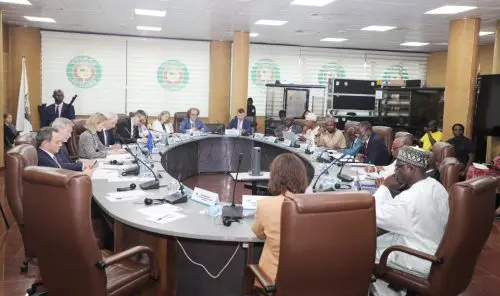
The Economic Community of West African States (ECOWAS) and the European Union (EU) held a high-level strategic meeting in Abuja on Sunday, March 23, 2026, reaffirming their commitment to regional stability and integration at a moment when the West African bloc is navigating its most testing period since its founding half a century ago.
ECOWAS Commission President H.E. Dr Omar Alieu Touray received EU High Representative for Foreign Affairs and Security Policy H.E. Ms Kaja Kallas for substantive talks covering security, governance, infrastructure, digital transformation, food security, and the socio-economic impact of rising energy costs. The engagement drew senior delegations from both institutions and was moderated by Jérôme Boa, Director of External Relations of the ECOWAS Commission.
The timing of the meeting carries weight. Following the formal withdrawal of Burkina Faso, Mali, and Niger from ECOWAS on January 29, 2025, the bloc now operates with 12 member states. Preserving the gains of integration across that reduced membership has become a central institutional priority, and the Abuja talks addressed that challenge directly.
Dr Touray told the EU delegation that ECOWAS had deliberately maintained the fundamental pillars of regional integration, including free movement, trade, and technical cooperation, to protect citizens and sustain cohesion through the recent political turbulence. “Our objective is to ensure continuity for our people while building confidence and defining clear modalities for sustainable collaboration,” he stated.
Ms Kallas, in turn, acknowledged ECOWAS as a cornerstone of regional stability and called for sharper coordination between regional organisations amid what she described as increasing global uncertainty. “At a time of increasing global uncertainty, cooperation between regional organisations is essential to ensure stability and to effectively respond to shared threats,” she said.
Commissioner for Political Affairs, Peace and Security, Ambassador Abdel-Fatau Musah, called for coordinated and inclusive responses to the evolving security landscape across the region. Commissioner for Internal Services Dr Habibu Yaya Bappah briefed the EU delegation on internal reforms the ECOWAS Commission is undertaking in accounting, finance, and procurement in preparation for an EU Pillar Assessment.
On the EU side, the delegation included Mr João T. G. Cravinho, EU Special Representative for the Sahel, and Ambassador Gautier Mignot, EU envoy to Nigeria and ECOWAS, underscoring the political and diplomatic depth of the engagement.
The meeting concluded with a renewed commitment to accelerate joint initiatives and deepen institutional cooperation across shared priority areas as ECOWAS prepares for a leadership transition in July 2026, when a new Commission is expected to take office.

