

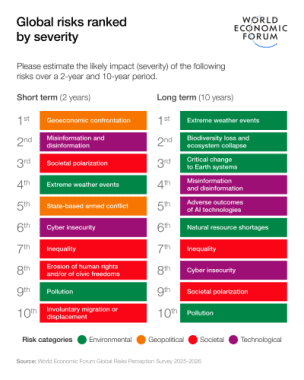
Geoeconomic confrontation emerged as the foremost global threat for 2026 in the World Economic Forum’s annual risk assessment, reflecting escalating tensions as major powers weaponize trade, finance and technology for strategic advantage.
The Global Risks Report 2026, published Tuesday from Geneva, surveyed over 1,300 leaders and experts worldwide who identified economic confrontation between nations as the risk most likely to trigger global crisis this year. Eighteen percent of respondents selected geoeconomic confrontation as the top immediate threat, followed by state based armed conflict at 14 percent, marking a dramatic shift from last year’s rankings where armed conflict held first position.
The report analyzes risks across three timeframes spanning 2026, the next two years through 2028, and the long term through 2036. Survey responses reveal deepening pessimism about near term prospects, with half of participants anticipating either turbulent or stormy conditions over the next two years, representing a 14 percentage point increase from the previous year’s assessment. Only one percent predict calm conditions.
Economic risks collectively showed the largest increases in severity rankings over the two year outlook. Economic downturn and inflation both surged eight positions to 11th and 21st respectively, while asset bubble burst climbed seven spots to 18th position. The constellation of mounting debt concerns, potential financial bubbles and geoeconomic tensions could herald a new phase of volatility potentially destabilizing societies and businesses, according to forum analysis.
Børge Brende, President and Chief Executive Officer of the World Economic Forum, characterized the shifting landscape as reflecting a new competitive order where major powers seek to secure spheres of interest. Despite changing cooperation dynamics, collaborative approaches and dialogue spirit remain essential for addressing shared challenges, he stated ahead of the forum’s Annual Meeting in Davos scheduled for January 19 through 23.
Misinformation and disinformation ranked second in the two year outlook while cyber insecurity placed sixth, highlighting technology related anxieties. Adverse outcomes from artificial intelligence demonstrated the starkest trajectory shift, climbing from 30th position in the two year horizon to fifth in the 10 year outlook, reflecting concerns about implications for labor markets, societies and security systems.
Societal polarization ranks fourth for 2026 and third by 2028, while inequality holds seventh position across both two year and 10 year outlooks. Inequality was selected as the most interconnected risk for the second consecutive year, fueling other threats as social mobility falters and cost of living pressures become entrenched in economies exhibiting stark inequality patterns.
Environmental risks declined in short term rankings despite remaining the most severe threats over the 10 year period. Extreme weather dropped from second to fourth position in the two year outlook, while pollution fell from sixth to ninth and critical changes to Earth systems plus biodiversity loss declined seven and five positions respectively. All environmental risks showed declining severity scores in absolute terms, not merely relative repositioning.
Three quarters of respondents expect turbulent or stormy environmental conditions over the coming decade, the most negative assessment among any risk category examined. The top three long term environmental threats identified are extreme weather events, biodiversity collapse and critical changes to planetary systems.
The geopolitical outlook shows 68 percent of respondents expecting a multipolar or fragmented order over the next decade, up four percentage points from last year. Only six percent anticipate revival of the postwar international order and its multilateral institutions as national interests increasingly supersede collective action frameworks.
Saadia Zahidi, Managing Director at the World Economic Forum, characterized the report as an early warning system documenting how the age of competition compounds global risks from geoeconomic confrontation to unchecked technology to rising debt while changing collective capacity to address challenges. However, none of these risks represent foregone conclusions, she emphasized.
The shift toward competitive dynamics follows extended periods of geopolitical turbulence, technological transformation and challenges to multilateralism and its institutions throughout 2025. Survey participants documented distinct movement toward an age of competition marked by confrontation rather than cooperation and trust, though resilience persists in certain sectors.
When risks unfold simultaneously across multiple domains, the phenomenon previously characterized as polycrisis intensifies systemic vulnerabilities. The current assessment examines how competitive ordering shapes impact across concurrent risk domains including kinetic warfare, deployment of economic weapons and growing societal fragmentation.
Short term concerns are overtaking long term objectives in policy prioritization, the report notes. As immediate risks from armed conflict, weaponized economic tools and societal division collide, longer term challenges from technological acceleration to environmental decline continue creating cascading effects across interconnected systems.
Supply chain disruption emerges as a critical vulnerability in a world of rising rivalries and prolonged conflicts at risk of regional spillover. Geoeconomic confrontation threatens core interconnected global economy functions, increasing state fragility through systemic, deliberate and far reaching consequences extending beyond immediate participants.
The technological landscape presents both opportunities and risks. Developments in quantum computing, artificial intelligence and related fields drive potential benefits spanning health, education, agriculture and infrastructure while simultaneously introducing vulnerabilities affecting labor markets, information integrity and autonomous weapons systems.
Rising societal and political polarization intensifies pressures on democratic systems as extremist social, cultural and political movements challenge institutional resilience and public trust. Growing prevalence of narratives pitting streets against elites reflect deepening disillusionment with traditional governance structures, leaving citizens feeling excluded from political decision making processes and increasingly skeptical that policy interventions can deliver tangible livelihood improvements.
The report emphasizes that future trajectories remain unfixed, dependent on decisions made today as a global community. Challenges spanning geopolitical shocks, rapid technological change, climate instability, societal strife and economic risks underscore both potential peril scale and shared responsibility for shaping outcomes.
Strategic competition intensification occurs while nations turn inward, requiring clear focus on understanding dangers ahead while maintaining or rebuilding capacity for collective action on shared challenges. New forms of global cooperation continue unfolding even amid competition, with global economy demonstrating resilience facing uncertainty.
The 21st edition of the Global Risks Report draws insights from the Global Risks Perception Survey alongside consultations with over 160 experts including the Global Risks Report Advisory Board, Chief Risk Officers Community and forum leadership communities across 11 thematic centers. The publication represents the forum’s flagship assessment on emerging threats and their potential cascading effects.
Effective dialogue, the core theme of the forthcoming Davos gathering, becomes vital for jointly shaping paths forward through emerging fault lines. Cooperation remains indispensable for global risk management despite increasing difficulty achieving coordination in more competitive environments. Only through rebuilding trust and establishing new collaborative mechanisms can leaders steer toward greater resilience and help shape more stable futures.
The forum complemented the risk assessment with scenario planning publications exploring strategic implications for businesses across different global economy trajectories to 2030. Four Futures for the New Economy examines interaction between geopolitical and technology drivers, while Four Futures for Jobs in the New Economy focuses on critical uncertainties regarding artificial intelligence and talent trends. Both publications offer tools for navigating uncertainty by identifying indicators to monitor, implications of each scenario and strategic moves preparing organizations for multiple possible futures.

