

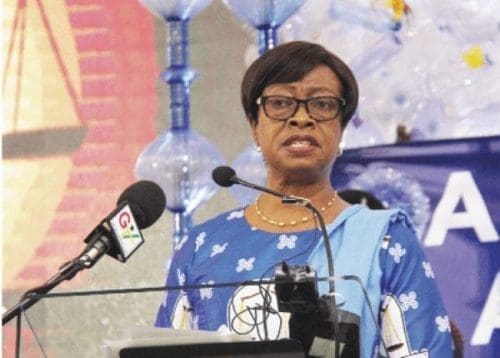
Former Chief Justice Sophia Akuffo has dismissed the government’s recently enacted mining fiscal amendments as internally contradictory, saying raising royalties while simultaneously cutting a key development levy amounts to moving money between pockets rather than capturing genuine value for Ghana.
Speaking at an Institute of Economic Affairs (IEA) press briefing in Accra on Wednesday, Justice Akuffo said the logic behind Parliament’s decision to introduce a sliding-scale royalty regime while reducing the Growth and Sustainability Levy (GSL) from 3 percent to 1 percent simply does not hold together. “Why did the government increase royalties ostensibly to capture greater value from Ghana’s mineral wealth, only to simultaneously dilute that gain through tax concessions? It’s like taking something from your left-hand pocket and putting it in your right-hand pocket,” she said. She described the approach as “Kwaku Ananse Mathematics,” invoking a widely understood Ghanaian expression for calculations that appear clever but ultimately yield nothing.
The GSL Amendment Bill, 2026 was passed by Parliament on March 14, one week after the Minerals and Mining Royalty Regulations, 2025 took legal effect. The royalty regulations introduced a sliding-scale structure that sets rates between 5 percent and 12 percent depending on prevailing gold prices. The government framed the GSL cut as a cushion to prevent the combined fiscal burden from becoming uncompetitive, but Justice Akuffo argued the concession defeats the stated objective of the royalty reform.
“The IEA views the reduction as a step that weakens the objective of maximising national benefits from the natural resources sector. Fiscal policy in the mining sector must be coherent. It must be predictable. And it must be aligned to a long-term national interest, not reactive concessions to investor pressure,” she said.
The IEA also used the briefing to question the ratification of the 15-year Ewoyaa lithium lease on March 19, 2026, saying the new agreement with Barari DV Limited, a subsidiary of Atlantic Lithium, locks Ghana into what it described as the same royalty-based structure the country should be moving away from, with virtually no actual state participation across a concession of over 42 square kilometres.
The IEA’s position goes further than the fiscal design debate. The institute has consistently argued that Ghana should move away from royalty-based arrangements entirely in favour of full state ownership of mineral resources, with private firms engaged strictly through service contracts. Justice Akuffo said countries including Norway, Botswana and Chile have demonstrated that this model delivers financial, economic and national security returns that royalty systems cannot match.
She acknowledged that the government has signalled an intent to reform the sector but said the actions taken so far fall short of that ambition. “Ghana must have full ownership of its natural and mineral resources,” she said, adding that capping national returns at 12 percent regardless of market conditions leaves significant value on the table.
The Ghana Chamber of Mines has separately described the GSL reduction as a welcome but insufficient step, and has proposed a narrower royalty band of 4 percent to 8 percent with wider price thresholds between brackets to prevent operators from being pushed into higher rate categories too quickly as gold prices rise. Gold was trading above US$4,600 per ounce at the time of the briefing.
The Ministry of Finance and the Ministry of Lands and Natural Resources had not publicly responded to the IEA’s latest critique as of Thursday, March 26.

