

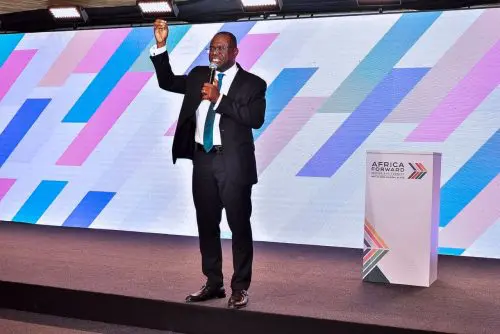
Jospong Group Executive Chairman Dr. Joseph Siaw Agyepong on Monday, May 11, confronted global financiers over restrictive capital conditions that lock African entrepreneurs out of international markets, telling delegates at the Africa Forward Summit in Nairobi that the continent demands partnership, not pity.
The summit, held at the University of Nairobi and co-hosted by Kenyan President William Ruto and French President Emmanuel Macron, brought together nearly 30 chief executives from Africa and France under the theme “To Build Together.”
Dr. Agyepong argued that Africa’s waste sector offers exactly what institutional investors claim to want: predictable, rising demand with long-term returns. He named the African Development Bank (AfDB), the International Finance Corporation (IFC), the Agence Française de Développement (AFD) Group, and European development finance institutions as specific collaboration targets, challenging each to move beyond conditional lending models that have historically slowed African-led solutions.
“Waste is not Africa’s shame. Waste is Africa’s next frontier,” he told the gathering.
The numbers he put forward were striking. Sub-Saharan Africa generates over 174 million tonnes of municipal solid waste every year, yet manages less than 4% of it properly. Europe, by contrast, recycles 48%. Globally, waste output sits at 2.1 billion tonnes annually and is projected to reach 3.8 billion tonnes by 2050.
Jospong Group, which Dr. Agyepong built from a $3 seed investment by his mother, now operates as a $1.9 billion asset-based conglomerate with 82 subsidiaries across 29 countries, employing 10,000 directly and supporting over 250,000 indirect jobs. The group runs 40 waste treatment plants covering material recovery, liquid waste, medical waste and hazardous waste, making it the largest waste management operator on the continent.
He committed to scaling the group’s environmental platform to five new African markets by 2028, generating 50,000 green jobs and opening its investment models to co-investors on equal terms.
The summit’s 400 youth delegates, whose perspectives feed directly into the final declaration, were among the audiences Dr. Agyepong addressed most directly. He called young Africans, who make up roughly 60% of the continent’s population, “our greatest hope and our most urgent responsibility,” and urged them to lead the digital transformation of the waste economy rather than wait for outside solutions.

