

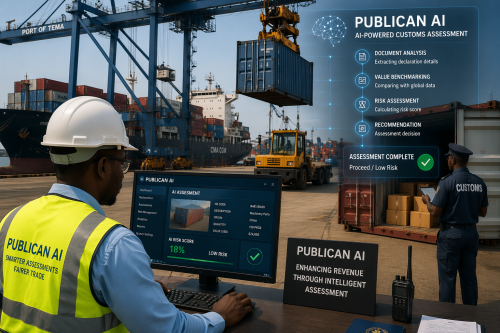
The Association of Ghana Industries (AGI) has held formal talks with the Ghana Revenue Authority (GRA) over the rollout of the Publican Artificial Intelligence (AI) customs valuation system, as Ghana’s ports remain at the centre of a widening dispute between government and trade stakeholders.
The engagement was aimed at clarifying concerns among manufacturers and importers regarding the system’s valuation methodology and dispute resolution framework. AGI, which represents manufacturers across sectors, pressed authorities on the accuracy of goods valuation and the responsiveness of the appeals mechanism. GRA Commissioner-General Anthony Sarpong indicated that complaints would be addressed within 48 hours through a dedicated process.
Sarpong has defended the system on revenue grounds, revealing that a five-year data review found Ghana lost more than GH¢11 billion in revenue through misclassification, under-declaration, and valuation irregularities at the ports. He described the losses as rooted in collusion among some shipping staff, customs officers, and importers, and said human-centred processes alone could not detect or prevent such schemes.
Sarpong also highlighted the system’s processing speed, saying document review times have been cut from over two hours to approximately five minutes.
The Publican AI system became mandatory for all import clearances on March 12, 2026, and operates alongside the existing Integrated Customs Management System (ICUMS), benchmarking declared import values against global trade data to detect under-invoicing.
However, the reform has drawn sustained opposition. A coalition of trade and freight forwarding bodies, including the Ghana Union of Traders’ Associations (GUTA), the Ghana Institute of Freight Forwarders (GIIFF), the Customs Brokers Association of Ghana (CUBAG), and the Freight Forwarders Association of Ghana (FFAG), launched a strike on April 13, 2026, citing unpredictable duty assessments, clearance delays, mounting demurrage costs, and the absence of a functional appeals mechanism.
Critics argue that the system operates as a minimum valuation regime, potentially in conflict with the World Trade Organization’s Customs Valuation Agreement, which requires transaction value to serve as the primary basis for customs taxation.
Analysts have pointed to comparable cases in India and Brazil, where AI-driven customs systems faced legal challenges and were ultimately repositioned as risk assessment support tools rather than binding valuation authorities. Some observers in Ghana are calling for a similar hybrid approach.
The GRA has established a joint technical committee and appeal mechanism to address implementation concerns, and an emergency stakeholder meeting was held on April 16.

