

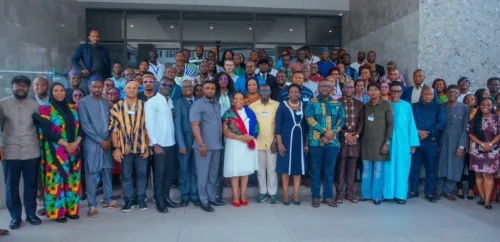
African nations closed a week-long meeting in Accra on Thursday with a sharpened continental agenda on artificial intelligence governance, cybersecurity, emergency communications, and the regulation of digital platforms, as the continent moves to assert greater influence over global telecommunications standards ahead of a pivotal 2028 assembly.
The five-day meeting, hosted by Ghana’s National Communications Authority (NCA) in collaboration with the International Telecommunication Union (ITU) and the African Telecommunications Union (ATU), brought together ministers, regulators, and technical experts from across the continent under the theme “Strengthening Africa’s Common Position for WTSA-28.”
The World Telecommunication Standardisation Assembly (WTSA-28), held every four years, is the principal forum through which the ITU’s Telecommunication Standardization Sector sets global technical standards and elects sector leadership. African nations use preparatory meetings to develop Common Positions, the formal mechanism through which the continent seeks to shape outcomes that reflect its development needs rather than simply adopting standards set elsewhere.
Communications Minister Samuel Nartey George pointed to Africa’s performance at the previous WTSA cycle as evidence of what coordinated action can deliver. Of the 37 Common Proposals submitted by African delegations at WTSA-24, 34 were adopted, covering new resolutions on artificial intelligence (AI), the Metaverse, and ITU strategic planning. Africa also secured 29 leadership positions across ITU structures, with experts from 13 countries serving as Chairs, Vice Chairs, and Telecommunication Standardisation Advisory Group (TSAG) Vice Chairs.
George stressed the need for African nations to become “rule makers, not just rule takers,” saying digital technologies were transforming economies and societies at an unprecedented pace and making active participation in global standardisation processes essential.
Specific outcomes from Accra
Delegates advanced proposals for a single standardised emergency telephone number across Africa, compatible with the international codes 112 and 911, as part of a joint ITU-ATU workshop running alongside the main preparatory sessions. Participants framed the initiative as foundational infrastructure for public safety and cross-border integration.
The agenda also addressed the governance of artificial intelligence, the resilience of submarine cable infrastructure, cybersecurity frameworks, the regulation of over-the-top (OTT) services such as messaging and streaming platforms, and affordable broadband access through infrastructure sharing. Speakers consistently called for standards that remain technology-neutral and flexible enough to accommodate new entrants rather than entrenching dominant incumbents.
On OTT regulation, delegates examined the “fair share” debate, which centres on how large digital platforms should contribute to the cost of telecommunications infrastructure investment across the continent, a question with direct financial implications for African network operators.
ATU Secretary-General John Omo stressed that more than 800 million Africans were still not using mobile internet, urging stakeholders to prioritise affordability, meaningful connectivity, emergency communications, cybersecurity, and artificial intelligence. “The decisions we make here in Accra will ripple across our digital landscape for years to come,” he said.
Ghana’s bid for the Radio Regulations Board
Ghana used the platform to seek support for the re-election of NCA Director-General Rev. Ing. Edmund Yirenkyi Fianko to the ITU Radio Regulations Board (RRB) at the next ITU Plenipotentiary Conference, scheduled for Doha, Qatar in November 2026. Officials highlighted Ghana’s investments in connectivity infrastructure and its Type Approval and Conformance Laboratories as evidence of growing national technical capacity.
The outcomes of the Accra meeting are expected to feed into Africa’s formal submissions ahead of WTSA-28, positioning the continent to arrive at the global assembly with a coordinated front capable of shaping the standards that will govern telecommunications infrastructure and digital services well into the next decade.

