

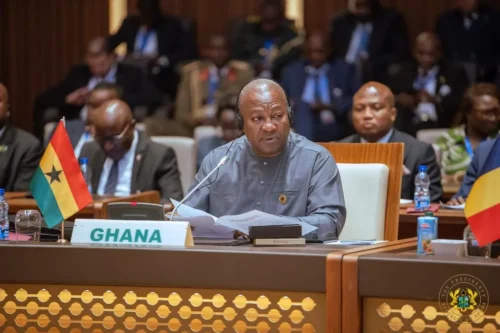
The United Nations General Assembly (UNGA) has adopted a landmark resolution declaring the transatlantic slave trade the gravest crime against humanity, with Ghana’s President John Dramani Mahama leading the charge at a session in New York on Wednesday that drew a rare and sharp divide between the Global South and the West.
The resolution, spearheaded by Ghana, received 123 votes in favour. Three countries, Argentina, Israel and the United States, voted against, and 52 abstained. The measure is not legally binding, but its passage represents the furthest the United Nations has gone in formally recognising transatlantic slavery as a crime against humanity and in calling for reparatory justice.
President Mahama, who serves as the African Union (AU) Champion for Reparations, addressed the General Assembly ahead of the vote on behalf of the 54-member African Group, the largest regional bloc at the United Nations. “The adoption of this resolution serves as a safeguard against forgetting,” he said. “Let it be recorded that when history beckoned, we did what was right for the memory of the millions who suffered the indignity of slavery.”
The resolution calls on member states to enter good-faith dialogue on reparatory justice, encompassing formal apologies, restitution, financial compensation, rehabilitation and guarantees against repetition. It also calls for the return of stolen cultural artefacts and for structural changes to address systemic racism and discrimination.
Ghana’s Foreign Minister Samuel Okudzeto Ablakwa said the resolution called for accountability and could pave the way for a reparative framework. Speaking after the vote, he characterised it as a turning point in how the world tells the history of slavery and its consequences.
Opposition came largely from Western nations. The United States said it does not recognise a legal right to reparations for historical wrongs that were not illegal under international law at the time they occurred, while the European Union raised concerns about applying modern legal frameworks retroactively. The Netherlands remains the only European country to have issued a formal apology for its role in the slave trade.
Justin Hansford, a law professor at Howard University, described the vote as significant, saying it marked the first floor vote on the subject at the United Nations and calling it a major step forward for the reparatory justice movement.
The vote took place on March 25, the International Day of Remembrance of the Victims of Slavery and the Transatlantic Slave Trade, the date in 1807 when Britain passed the Abolition of the Slave Trade Act. NewsGhana reported ahead of the session that Ghana had spent more than a year building a coalition for the resolution, drawing backing from all 55 AU member states, Caribbean Community (CARICOM) nations, Brazil and the Community of Latin American and Caribbean States.
The African Union reacted to the vote by reaffirming its commitment to the Decade of Action on Reparations and African Heritage covering 2026 to 2036. President Mahama has said Ghana intends to use that framework to advance concrete multilateral reparatory measures, and has separately called for permanent African representation on the UN Security Council as part of a broader reset of global institutions.

