

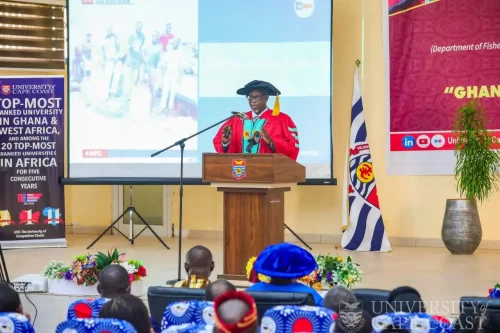
A fisheries professor at the University of Cape Coast (UCC) has proposed the elimination of minor landing beaches across Ghana’s coastline, arguing that the country’s more than 300 landing sites spread across approximately 550 kilometres are too numerous to police effectively and are actively enabling illegal fishing.
Prof. Joseph Aggrey-Fynn, a Professor of Fisheries and Aquatic Sciences at UCC, made the call during his professorial inaugural lecture in Cape Coast, warning that the proliferation of small landing sites had created serious gaps in the enforcement of fisheries regulations. He said consolidating them into fewer, properly resourced facilities would make it far easier to inspect vessels, intercept illegal gear and regulate activity before boats even leave shore.
“In some countries, before a boat leaves for fishing, the gear and equipment are inspected. That makes it impossible to go to sea with illegal tools. But in places like Elmina, you can clearly see fishermen carrying generators, which means they are going for light fishing,” he said.
Prof. Aggrey-Fynn warned that rapidly declining fish stocks, particularly of the Sardinella species, were placing the industry under severe strain, and that the fisheries sector contributes approximately 1.2 percent to national Gross Domestic Product (GDP) while supplying roughly 60 percent of the country’s annual protein needs.
Beyond enforcement, the professor laid out what he described as a largely untapped economic frontier in marine tourism. He said Ghana’s coastal waters from Winneba to the Western Region were home to whales and dolphins, and that the country could build a viable whale-watching and dolphin-watching industry modelled on countries such as Cape Verde, where marine tourism already contributes meaningfully to national revenue.
Prof. Aggrey-Fynn highlighted the vast economic opportunities within Ghana’s marine environment, noting that the country had barely tapped its potential, and pointed to possibilities ranging from eco-tourism to pharmaceutical research and food industry innovation already being exploited elsewhere.
He called for greater government investment in the Blue Economy to ease pressure on fish stocks while generating new income streams through ocean transport, coastal tourism and other marine-based activities.
The professor also disclosed that UCC was preparing to launch the Africa Ocean Institute (AOI) in Accra before July. The AOI is structured around three existing UCC units and its thematic priorities include food security, climate resilience, biodiversity conservation, marine pollution and policy integration, with a focus on supporting sustainable fisheries management and unlocking broader business opportunities. He appealed to the government and development partners to back the initiative, stressing that stronger research and improved policy coordination were essential to reversing the decline of Ghana’s fisheries sector.

