

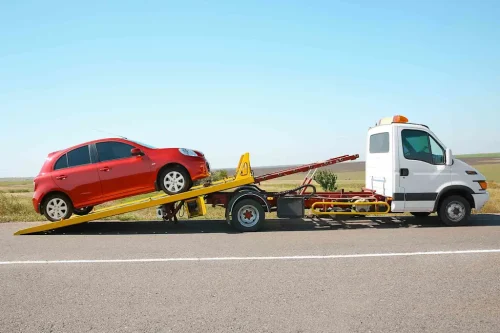
The persistent gridlock on the Accra-Kumasi highway is reviving calls for a structured national towing policy, with an engineer urging the government to reintroduce a vehicle removal levy that was scrapped years ago after a public backlash rooted in poor communication rather than the policy’s merits.
Building and construction engineer Ing. Abdulai Mahama, speaking to The High Street Journal, argued that broken-down and abandoned vehicles remain a major but underaddressed driver of congestion on the corridor, which links Ghana’s two largest economic cities and carries some of the country’s heaviest freight and passenger traffic.
The highway became a national flashpoint after motorists spent between 12 and 24 hours stranded in gridlock on sections of the corridor over the New Year period, prompting President John Dramani Mahama to defend plans for a new expressway as an urgent national necessity. A fresh wave of severe congestion driven by stationary cargo trucks struck the Nkawkaw-Jejeti stretch on May 1, 2026, marking the third serious episode along the corridor in two weeks.
Against that backdrop, Ing. Mahama is pressing for a reset on towing policy. The government previously cancelled the mandatory towing levy that had been scheduled for implementation on July 1, 2017, following the passage of Legislative Instrument 2180 under the Road Traffic Regulations, 2012, which imposed a mandatory fee on vehicle owners for the removal of broken-down vehicles from Ghana’s roads. The cancellation followed extensive stakeholder consultations and a public outcry over the financial burden the levy would impose.
Ing. Mahama argues the problem the policy was designed to solve has not only persisted but intensified. He believes the current government has an opportunity to reintroduce the concept with a sharply improved communication strategy, integrating the levy transparently into existing vehicle ownership fees such as insurance and roadworthiness charges rather than presenting it as a new standalone imposition.
“I have spoken countless times on that particular item, where initially, it was the government that wanted to introduce a towing policy. But I think they couldn’t communicate it well. I don’t think it stops this current government from enhancing education so that we understand that the reason why we have to pay a certain quota when we are going to do our roadworthy, when we are going to insure our vehicles, and all that,” he said.
Beyond the levy question, Ing. Mahama stressed the operational case for physically stationing towing trucks at known accident-prone and high-traffic sections of the highway. Without a guaranteed rapid-clearance system for disabled vehicles, he warned, congestion will remain a self-perpetuating problem regardless of what new infrastructure is built.
Road safety advocates have previously estimated that disabled vehicles on major highways account for approximately 11 percent of road crashes, with organisations calling for stronger public education on any reintroduced levy to avoid the resistance that derailed the earlier attempt.
The calls reflect a broader frustration with reactive traffic management on a corridor that the government has itself identified as one of Ghana’s most critical infrastructure priorities.

