

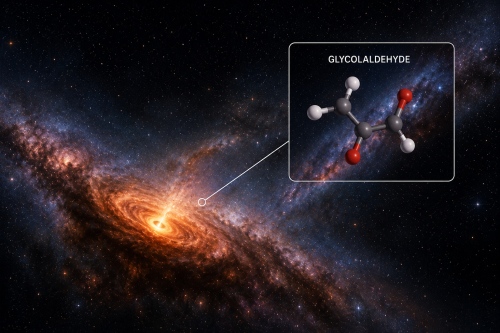
Astronomers have identified erythrulose, a four carbon sugar, drifting in a molecular cloud roughly 26,745 light years from Earth near the Milky Way’s center, the first confirmed sugar detected in the space between stars.
The finding, published in Nature Astronomy, gives fresh weight to a long running theory: some of the chemical building blocks life needs may have formed in interstellar clouds long before Earth existed, then hitched a ride to young planets aboard comets and asteroids.
“This is an incredibly exciting result,” said Brett McGuire, an astrochemist at the Massachusetts Institute of Technology who was not involved in the study. Astronomers have chased evidence of sugars in space for decades, he noted, ever since a simpler two carbon compound called glycolaldehyde turned up in interstellar gas in 2000. That molecule behaves somewhat like a sugar but lacks the three carbon backbone needed to count as one. Erythrulose clears that bar.
A team led by Izaskun Jimenez Serra of Spain’s Center for Astrobiology and the Spanish National Research Council made the detection using the Yebes 40 meter radio telescope near Madrid and the Institute for Radio Astronomy in the Millimeter Range (IRAM) telescope in southern Spain. Both instruments scanned a dense gas cloud called G+0.693 minus 0.027, a region so chemically active that Jimenez Serra has described it as one of the richest reservoirs in the galaxy.
The researchers had expected to find simpler three carbon sugars first, based on the standard assumption that interstellar molecules grow step by step, one carbon atom at a time. They found none. Erythrulose turned up instead, at levels at least eight times higher than any three carbon sugar the team could detect, and matched its radio signature against laboratory measurements to confirm the identification.
Chemical modeling suggests the sugar formed efficiently on icy dust grains from smaller molecules, including glycolaldehyde and ethylene glycol, both already known to exist in the same cloud.
Scientists have previously found sugars such as ribose and glucose inside meteorites and in samples the NASA OSIRIS REx mission collected from the asteroid Bennu, supporting the idea that space delivered at least some of Earth’s early organic material. Researchers estimate that between 500,000 and 50 million metric tons of erythrulose could have reached Earth during the Late Heavy Bombardment about 4 billion years ago, a period when asteroid impacts on the inner planets were far more frequent than today, though scientists still debate how intense that bombardment actually was.
Mark Sephton, a professor of Earth science at Imperial College London who had no role in the research, said sugars likely became trapped in asteroids as they formed and later reached Earth’s surface through impacts.
The team is now searching the same cloud for other biologically important sugars, including ribose, a component of RNA. If space can manufacture a four carbon sugar in the near vacuum between stars, researchers say, it may be capable of building far more complex molecules than anyone has confirmed so far.

