

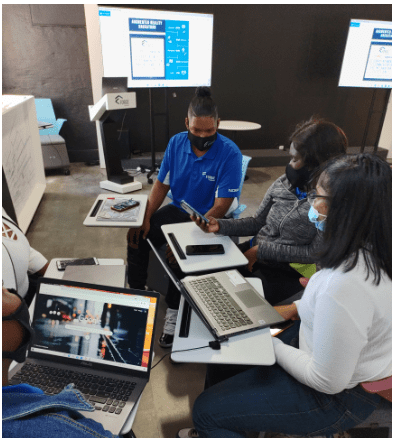
Forge Academy, South Africa’s first fully inclusive 4IR laboratory and digital learning hub, recently hosted an augmented reality workshop at The Gantry in Fourways, Gauteng.
Students enrolled at Forge Academy volunteered in groups to conceptualise and develop an augmented reality walk-through assistant known as a ‘guidebot’. Students captured images of the Forge Academy building for a 360-degree augmented presentation. They then designed the walk-through assistant that will lead visitors through the Forge Academy lab, put together the strategy of how the guidebot would function and provided explanations of the walk-through.
The walk-through assistant will allow businesses to provide their clients with a virtual tour of their facilities. Whether it be a hotel, a university or a factory, the guidebot will mimic a real-life experience for users interacting with a specific place of interest, using augmented reality technology. The guidebot works with visual recognition and positioning based on 3D scans.
“With the Covid-19 pandemic restricting the physical contact that we have with each other, this technology goes a long way to bridging the communications gap. A guidebot can allow shoppers to avoid using interactive information panels at shopping malls where physical touch is needed. Furthermore, shoppers and service providers can avoid direct contact during an exchange which helps to reduce the risk of Covid-19 infections and keeps everyone safe,” said Arthur Wade Anderson, CEO of Forge Academy.
Bridge, a company that specialises in augmented reality (AR), partnered with Forge Academy in the workshop. Their technical lead experts showed students the ropes, giving them a framework of how to work on the AR Bridge platform.
HMD, the global supplier of mobile phones to Nokia, sponsored 10 Nokia 8.3 smartphones for the workshop. The phone’s cameras captured the images needed for 3D mapping and assisted students in conceptualising and developing the guidebot. The phone was also used for concept designs and for building the look and feel of the walkthrough assistant for the end-user. The phones are also being used in the testing phases of the guidebot.
“A great morning spent at Forge Academy, seeing the Nokia 8.3 5G’s and Nokia 2.3’s being put to the test with the students developing and presenting their AR projects. Having access to both higher and mid-range Nokia smartphones allowed the students to understand the different performance ranges and how they needed to tweak their design thinking processes. We look forward to collaborating with Forge Academy in upcoming events” – Nicole Austin (Channel Marketing Manager HMD)
The students who participated in the workshop range from 19 to 25 years of age and are studying courses in telecommunications and digital marketing at Forge Academy.
Students were split into different task groups for the project and all these tasks will be pulled together into one holistic product to build a complete guidebot.
“We are currently fine-tuning the concept designs and compiling them into one holistic product. After this, we will implement mapping software and concept designs into a testable guidebot that we can eventually release into the market,” said Anderson.

