

A South African court has reserved judgment in a landmark environmental case that could determine the future of ultra-deep-water oil and gas exploration off the country’s west coast, after two days of hearings concluded at the Western Cape High Court.
The case, brought by the Aukotowa Primary Fishing Co-operative, The Green Connection, and Natural Justice, challenges the environmental authorisation granted to TotalEnergies EP South Africa for exploration drilling in the Deep Western Orange Basin (DWOB), approximately 200 kilometres off the South African coastline. The applicants asked a full bench of the court to review and set aside both the Director-General’s original 2023 approval and the Minister of Forestry, Fisheries and Environment’s subsequent dismissal of their appeals. The court will deliver judgment in due course.
At the centre of the legal challenge is the applicants’ argument that the environmental authorisation process was unlawful, irrational, and inconsistent with constitutional, environmental, and climate obligations. They maintained that the Environmental Impact Assessment (EIA) failed to adequately address the risks specific to drilling at depths exceeding 2,000 metres, conditions that are entirely without precedent in South African waters, and that no adequately tested blowout contingency plan exists for this region.
The applicants also argued that the state applied an artificially narrow lifecycle assessment, evaluating only the exploration phase in isolation rather than accounting for the climate impact of eventual extraction and combustion under the National Environmental Management Act (NEMA). They contended that the so-called bridge fuel argument used to justify the project is scientifically outdated and incompatible with South Africa’s net-zero commitments, particularly in light of the International Court of Justice’s (ICJ) recent advisory opinion obliging states to avoid significant harm to the global climate system.
A separate but related legal argument centred on the failure to properly apply the Integrated Coastal Management Act (ICMA), which the applicants said imposes clear duties on the state as public trustee of the coastline for the benefit of current and future generations.
TotalEnergies EP South Africa, which holds a 50 percent operating stake in the DWOB block alongside QatarEnergy with 30 percent and Sezigyn with 20 percent, defended the authorisation. Its legal counsel argued that compliance with NEMA automatically satisfied ICMA requirements, and that the statistical probability of a blowout at depth was extremely low by global industry standards.
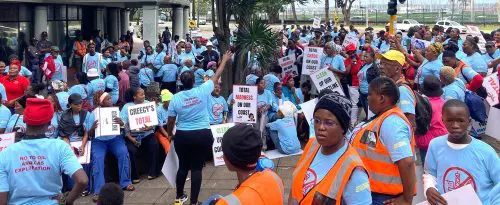
Outside the court on the opening day of proceedings, nearly 100 small-scale fishers and coastal community members staged a peaceful protest, with solidarity actions held separately in parts of the Eastern Cape and KwaZulu-Natal. Fishing cooperative representatives argued that the approval process ignored their livelihoods, food security, and cultural heritage, and that declining fish stocks along the west coast had already placed coastal communities under severe pressure before any new offshore risk was introduced.
The case represents one of the most significant eco-justice challenges to offshore fossil fuel expansion in sub-Saharan Africa and is being watched closely by energy, legal, and environmental communities across the continent.

