Mandela Family, Datavault AI Detail Stablecoin Plan

0

Nelson Mandela’s granddaughter Zaziwe Dlamini-Manaway and technology partner Datavault AI have laid out both the rationale and the technical architecture behind a proposed stablecoin called the Mandela Dollar, while confirming the project remains an early stage plan with no live product yet.

The token, known as MUSD, is being developed by Mandela Digital, a joint venture formed this month between Nasdaq listed Datavault AI Inc, financial structuring firm Unity Reserve Holdings, and Mandela Dlamini and Manaway LLC, a Wyoming based entity affiliated with members of the Mandela family. It is designed as a dollar pegged digital currency aimed at remittances, savings and micro-lending for unbanked and underbanked communities across Africa, Southeast Asia, Latin America and diaspora corridors worldwide. Datavault AI’s own disclosures are explicit that MUSD remains a proposal rather than a live product: it has not yet been developed or launched on any exchange or blockchain, no token sale of any kind has been authorised, and the companies involved say there is no assurance the coin will ultimately be launched or approved in any jurisdiction. The public has been cautioned against any unauthorised tokens or accounts claiming to represent it.

Dlamini-Manaway, a director of MDM LLC, frames the project as continuing a specific piece of unfinished business from her grandfather’s presidency. “During his lifetime, freedom and democracy was realised, we still need to fulfil his vision for economic empowerment for Africa and the underserved communities globally,” she said, arguing that dignity for the poor cannot be separated from access to basic financial tools. She said the family sees itself as custodian of that legacy rather than simply a licensor of the Mandela name. “We are very cognizant of the partnerships we lend our name to and are guided by the wishes and instruction personally given to us by our grandfather,” she said.

Datavault AI chief executive Nathaniel Bradley set out the technical case behind that trust. He said the venture’s security architecture rests on infrastructure from Available Infrastructure, a Virginia based edge computing firm whose SanQtum platform runs IBM’s watsonx AI software across a network of small, localised data centres rather than distant central clouds, a collaboration Datavault AI and IBM have confirmed separately from the Mandela Dollar announcement. Bradley described the combination as a “quantum resistant” security layer intended to protect transactions against both current threats and future attacks from quantum computers, paired with zero trust verification in which every access and transaction is continuously checked rather than automatically trusted. It is worth noting that “quantum resistant” and “quantum ready” are Available Infrastructure’s own description of its architecture rather than an IBM branded product, and that IBM’s confirmed role is supplying AI software rather than a specific quantum encryption technology.

Beyond security, Bradley said MUSD’s design follows a fairly conventional stablecoin template: reserves held in segregated custody, independent audits and real time on-chain proof-of-reserve publication, structured to align with the US GENIUS Act signed into law in July 2025, which requires payment stablecoins to hold one-to-one reserves and disclose them monthly. Governance sits with a joint board representing Datavault AI, Unity Reserve Holdings and MDM LLC. Bradley pointed to MUSD’s intended low fees for remittance corridors and a planned share of protocol revenue directed toward Mandela aligned education and anti-poverty programmes as features he said most other dollar backed stablecoins do not build in, alongside longer term ambitions to tokenise real world assets such as agricultural produce or carbon credits for African entrepreneurs, goals that remain aspirational rather than active projects.

The commercial side of the venture is smaller than the ambition behind it. Datavault AI reported revenue of about 41.9 million dollars over the past twelve months, while its shares have traded near 36 cents, down over the past week around the time of the announcement. On timing, Bradley said the joint venture is “currently in the construction phase,” with the next 12 months expected to bring technology integration, regulatory engagement, wallet and exchange integration work, and pilot testing in priority African and emerging market corridors, all explicitly contingent on regulatory approval and market conditions. No pilot has begun.

MUSD would enter a market shaped by both opportunity and new regulation. The World Bank estimated remittances to low and middle income countries reached about 685 billion dollars in 2024, with the average cost of sending money still running more than double the United Nations’ 3 percent target, the gap stablecoin backers argue their technology can close. Stablecoins in circulation globally surpassed 300 billion dollars in 2026, according to DeFiLlama.

The announcement lands ahead of Nelson Mandela International Day on July 18, marked worldwide by 67 minutes of volunteer service. Dlamini-Manaway said this year’s theme, that combating poverty and inequality remains in people’s own hands, applies as much to Africa’s economic future as to any single day of service. “Africa will only succeed if we want better for ourselves,” she said. “There is no other option.”

Team Volta supports National Sanitation Exercise in Damba

In support of the President’s National Sanitation Exercise, Team Volta Management joined the Dambai District in the Oti Region for a clean-up exercise to promote environmental cleanliness.

The team also paid a courtesy call on the Oti Regional Minister, Hon. John Kwadwo Gyapong, where discussions centred on electricity supply, commercial operations, energy conservation and development priorities for the Region.

The Regional General Manager, Ms. Christina Jatoe-Kaleo, encouraged stronger sanitation enforcement to help keep communities clean and shared practical energy-saving measures to reduce electricity costs.

The Regional Minister commended ECG Management for the initiative and praised the Dambai District team, led by Madam Irene Mary Odame, for their dedication and service. He also appealed for ECG’s support in extending electricity to the Oti Regional Coordinating Council’s new office complex.

Together, through collaboration, we are powering development and building cleaner, more sustainable communities.

Europe Pours Billions Into Military Drone Push

0

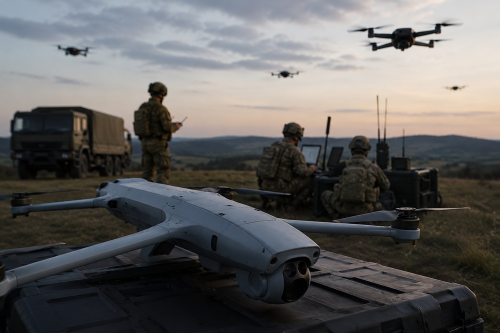
European governments and NATO have announced tens of billions of dollars in new drone and counter-drone spending in the past two weeks, reshaping military planning after lessons from Ukraine.

NATO unveiled its Drone Edge Initiative, committing more than 40 billion dollars to counter-drone capabilities over five years with 20 allied nations currently involved, alongside plans to train five times as many drone operators by the end of 2027. Britain committed 5 billion pounds, about 6.7 billion dollars, to a UK drone transformation programme under its Defence Investment Plan published in late June. Germany moved to buy 50,000 drones for Ukraine through a 90 million euro, roughly 105 million dollar, order placed with defence software firm Auterion and Ukrainian manufacturer Skyfall. The same week, Munich based Helsing closed a 1.8 billion dollar funding round that valued the company at 18 billion dollars, making it Europe’s most highly valued privately held defence company.

The counter-drone push follows a string of real incidents rather than only theoretical concern. Long range drones linked to the Russia-Ukraine war have crossed into NATO territory in Poland, Romania, Latvia and Estonia, prompting the alliance to scramble fighter jets, while unexplained drone sightings over Denmark, Germany, France, Belgium and the Netherlands have added to unease among member states. “Drones have fundamentally altered the character of modern warfare,” NATO Secretary General Mark Rutte said, calling them a decisive factor on the battlefield.

The Auterion order illustrates how the economics of drone warfare are shifting. Each unit costs roughly 2,050 dollars including ground control stations and programme overhead, more than Ukraine’s cheapest manually piloted drones but far below the cost of traditional precision guided munitions. Auterion’s operating system lets drones keep locking onto and tracking targets even when jamming disrupts GPS or radio contact, and lets them strike targets below the radio horizon, such as when a drone descends into a valley. The company plans to add software allowing operators to fly and strike with coordinated swarms rather than piloting each aircraft individually. “Software defines the modern battlefield,” Auterion chief executive Lorenz Meier said, adding that armed forces in Germany, Norway, Britain and France have already shown interest in the technology beyond the Ukraine order.

The drone pledges arrived alongside a broader wave of procurement at NATO’s Ankara summit, including an estimated 5 billion dollar deal for eleven countries to adopt Sweden’s Saab airborne radar system and a roughly 2.7 billion dollar acquisition of Northrop Grumman Triton surveillance aircraft by Denmark, Finland, Germany and Norway, alongside new NATO initiatives meant to simplify how defence companies access alliance contracts and coordinate manufacturing capacity across member states.

Morningstar analyst Loredana Muharremi said the shift points to a more networked battlefield, where a tank increasingly launches drones and shares live targeting data with satellites and other aircraft rather than simply firing shells, creating openings for companies working in autonomy, sensors, electronic warfare and secure communications, not just drone manufacturers themselves. European core defence spending has already doubled since 2019 and could reach about 800 billion euros by 2030, equivalent to roughly 2.9 percent of GDP, if NATO’s target of 3.5 percent by 2035 is met, according to McKinsey. Venture capital investment in defence technology more than doubled in 2025, with European defence tech funding climbing from about 200 million euros in 2021 to 2.6 billion euros last year. Helsing itself builds drones, underwater surveillance systems and autonomous software, positioning it at the centre of Europe’s bet that software will define the next generation of warfare as much as hardware does.

GTBank Named Nigeria’s Top Bank By The Banker

0

GTBank has been ranked Nigeria’s best performing bank in The Banker magazine’s Top 1000 World Banks Rankings 2026, topping peers in efficiency and financial soundness.

The annual rankings assess banks worldwide using audited financial statements, scoring institutions on financial strength, operational efficiency, liquidity, profitability, growth, leverage and risk management. GTBank finished first overall among Nigerian banks and topped the Efficiency and Soundness categories outright, while placing second nationally in Return on Risk, Liquidity, Growth, Leverage and Profitability. GTBank Managing Director Miriam Olusanya credited the result to the bank’s workforce, its customers and the backing of parent company Guaranty Trust Holding Company. “We do not take this recognition for granted,” she said, framing it as motivation to keep improving service rather than a settled achievement, at a time when Nigerian lenders are contending with high interest rates, currency volatility and a difficult macroeconomic environment more broadly.

The numbers behind the ranking point to why GTBank scored where it did. GTCO reported profit before tax of 1.23 trillion naira, about 800 million dollars, for the year ended December 31, 2025, on the back of growth in lending, transaction fees and other core banking income, with profit after tax at 865.8 billion naira. Total assets rose to 17.8 trillion naira and customer deposits climbed nearly 24 percent to 12.9 trillion naira. The group’s capital adequacy ratio stood at 43.8 percent, well above regulatory minimums, while its cost to income ratio improved to 27.9 percent, among the lowest of any Nigerian bank. GTCO chief executive Segun Agbaje said after the results that the group remained focused on scaling its ecosystem and driving innovation across its financial services platform.

The recognition lands within a global ranking increasingly shaped by geopolitics as much as balance sheets. This year’s Top 1000 edition highlighted China’s continued grip on the summit of global banking, propped up substantially by state support even as profitability among Chinese state lenders trails global peers, particularly in the United States, against a backdrop of rising US China tensions and new tariff regimes introduced through 2025. Within that landscape, GTBank’s showing reinforces its standing among Africa’s stronger banking franchises, an image the group has been building beyond core banking through digital payments, pension fund administration and asset management operations spanning Africa and the United Kingdom.

Airtel Money IPO Valuation Hits US$10 Billion

Airtel Africa is preparing a London listing for Airtel Money that could value the mobile money unit at $7 billion to $10 billion, targeting the second half of 2026.

Citigroup continues to lead the transaction, with three or four additional banks expected to join the syndicate as the process advances. The offering could raise between $1.5 billion and $2 billion, a deal size that would rank among the largest listings on a European exchange in recent years. London edged out an earlier preference for a Middle Eastern exchange, and other European venues considered along the way, though people familiar with the plans caution that the final decision on size, timing and location has not been locked in.

The timeline has already slipped once. Airtel Africa chief executive Sunil Taldar had targeted a listing by the middle of 2026, but the company pushed the offering into the second half, attributing the delay to “market conditions following recent geopolitical developments,” a reference to the volatility stemming from the ongoing Iran Israel US conflict rather than conditions specific to Airtel itself. The company has some room to manage that slippage: TPG and Mastercard, both existing investors in the unit, agreed in August 2025 to defer the exercise of their put options by 12 months, effectively giving Airtel until around mid-2026 to get the listing done.

The business behind the IPO has grown quickly enough to justify the scale of interest. Airtel Money’s customer base has climbed from about 21 million users at the time of TPG’s original 2021 investment to 54.1 million by March 2026, while revenue for the nine months to December 2025 rose 29.4 percent to 986 million dollars. Annualised total transaction value processed through the platform crossed 215 billion dollars in the most recent quarter, extending a run of double digit growth. That trajectory has repeatedly pushed the unit’s implied valuation higher: TPG’s original 2021 investment of 200 million dollars valued the business at 2.65 billion dollars, a pitch to investors in September 2025 put it above 4 billion dollars, and the range now under discussion sits at 7 billion to 10 billion dollars, roughly a fourfold increase in five years. Beyond TPG and Mastercard, an affiliate of Qatar’s sovereign wealth fund, the Qatar Investment Authority, is also among the unit’s existing investors.

The listing process coincides with a leadership change at the top of Airtel Africa. Founder Sunil Mittal is stepping down as chairman after seven years in the role, handing over this month to Gopal Vittal, currently chief executive of Bharti Airtel in India. Whoever ultimately oversees the float, it would represent the biggest strategic move for Airtel Africa since its own London listing in 2019. The company is currently listed on both the London and Lagos stock exchanges, and a successful Airtel Money IPO would add to a London market that has struggled in recent years to compete with New York for major growth company listings amid a wave of takeovers that has shrunk the roster of publicly traded UK companies.

Cabinet Restores Achimota Forest, Reverses 2022 Move

Ghana’s government has reversed a controversial 2022 decision that stripped part of Achimota Forest of its protected status, restoring it as Accra’s last major urban green space.

The reversal undoes Executive Instrument 144, gazetted in April 2022 under the previous administration, which excised roughly 361.5 acres from the southern section of the reserve and returned the land to the Owoo family, who had claimed to be its pre-acquisition owners. The move sparked sustained public backlash at the time from environmental groups, civil society organisations and members of parliament. Announcing the reversal at the Government Accountability Series on Wednesday, Lands and Natural Resources Minister Emmanuel Armah-Kofi Buah said Cabinet approved the revocation of E.I. 144, as amended by E.I. 234, on June 24, restoring the reserve to its original protected classification and creating what he called an ecological safety zone for Accra. “This is the only last man standing forest cover in Accra,” he said, adding that President Mahama was determined to protect it regardless of cost.

Buah paired the Achimota announcement with an update on Ghana’s timber trade credentials. The country issued 411 Forest Law Enforcement, Governance and Trade licences in the second quarter of 2026, pushing its cumulative total past 600 since becoming the first African country, and only the second worldwide after Indonesia, to qualify for the certification in August 2025, when the first licences went to five companies including Samatex and Miro Plantations. Licensed shipments now reach 22 European Union destinations, with Buah saying every certified export carries verified proof of legal and sustainable origin.

On reforestation, the government’s Tree for Life initiative planted about 31 million seedlings in 2025, with survival rates of 50 to 78 percent in the northern savannah zone and 65 to 85 percent in the High Forest Zone, restoring roughly 23,600 hectares of degraded land. The Forestry Commission has set a 30 million seedling target for the season that began June 5, backed by 2,719 Youth Forest Champions handling nursery work, site preparation and wildfire prevention.

Enforcement against illegal mining in forest reserves has also stepped up, with joint operations by the Ministry and the Forestry Commission producing 258 arrests, the demobilisation of six excavators and 765 Changfan machines, the seizure of 1,225 pumping machines, and the destruction of 430 structures and 35 tricycles. Buah said Ghana has recorded no Red zones since December 2025. On reclamation, 1,535 acres of degraded land have been restored in the Ashanti Region in partnership with the private sector, which has committed to a further 1,500 acres by year end, alongside a separate government effort targeting 960 acres nationwide. The Ministry is also drafting a Legislative Instrument to operationalise the Wildlife Resources Management Act, formalising Community Resource Management Areas, while ecotourism upgrades continue at Shai Hills Resource Reserve and Mole National Park.

Analyst Warns Mobile Money Poses Systemic Risk

0

Banking analyst Richmond Atuahene is warning that Ghana’s mobile money boom, dominated by MTN, could pose a systemic risk to the economy without stronger regulation.

Atuahene cites MTN’s own figures showing it controlled 81.29 percent of Ghana’s mobile data subscriptions as of February 2026, with its mobile money platform serving more than 19.3 million active users. He likens the resulting concentration to a spider’s web, arguing that a prolonged outage or financial distress at the dominant provider could ripple across a financial system where banks, telecoms, merchants and consumers are now tightly interconnected through digital payments, creating what he calls a too big to fail situation for regulators to watch closely.

That concentration is no longer just a telecom side business. In early 2026, MTN formally carved its mobile money operation out into a standalone fintech subsidiary, Mobile Money Fintech Limited, a restructuring the company itself has framed as a move to operate less like an add on to a phone network and more like a full financial institution, with a possible Ghana Stock Exchange listing floated within three to five years. That shift lends weight to Atuahene’s underlying argument that a telecom operator is increasingly performing bank like functions rather than undercutting it.

His concern about fees is not hypothetical either. The Bank of Ghana suspended a proposed 0.75 percent fee MMFL wanted to charge on wallet to bank transfers in late May, blocking it days before it was due to take effect on June 1 pending further consultation with industry stakeholders, an early sign regulators are already engaging with the kind of fee concerns Atuahene is raising. On cybersecurity, Ghana Bankers Association data for the first quarter of 2026 put mobile money fraud at 31.5 percent of all recorded fraud cases, the largest share of any category, while a 2024 E-Crime Bureau study found 65 percent of mobile money users had been targeted by or fallen victim to fraud. Attempted fraud losses in that quarter alone reached GH¢143,108, with banks recovering almost none of it. The central bank tightened its rules for electronic money issuers in January 2024, requiring two factor authentication and mandatory cybersecurity audits, a floor Atuahene has separately argued needs reinforcement, including through AI based anomaly detection on agent networks.

On monetary policy, Atuahene compares the flow of money into mobile wallets to water diverted through alternative pipes, weakening the pressure the Bank of Ghana can exert through conventional tools as more funds sit outside the traditional banking system. His push for stronger oversight of mobile money fits a broader position he has taken this year, having separately called for the central bank to create a standing body dedicated to systemic risk. “The Bank of Ghana must establish a Financial Stability Committee,” he has said, pointing to the 2022 and 2023 Domestic Debt Exchange Programme as the clearest recent case of systemic risk materialising without such an institution in place.

COMAC CEO: Crude, Cedi Drive Fuel Prices

0

COMAC CEO Riverson Oppong says international crude prices and the cedi’s exchange rate, not government, remain the biggest drivers of fuel prices at Ghana’s pumps.

Speaking on the Asaase Breakfast Show, Oppong said prices are reviewed every two weeks under Ghana’s deregulated pricing system using average international benchmarks and the prevailing dollar rate. “The government has no say in whatever prices we have,” he said, describing benchmark crude prices and the exchange rate as the two variables that actually move pump prices window to window.

The pricing window now in effect illustrates the point with unusually precise numbers. Ahead of the adjustment that took effect on July 16, the National Petroleum Authority raised its price floor for petrol from GH¢12.79 to GH¢13.28 a litre, a 3.8 percent rise, diesel from GH¢13.54 to GH¢14.35, up 6.0 percent, and LPG from GH¢10.11 to GH¢10.19 a kilogram, up 0.8 percent. The cedi itself moved against consumers this window, slipping from GH¢11.4333 to GH¢11.4970 to the dollar, a 0.55 percent depreciation, rather than cushioning the increase. On the crude side, average prices had initially fallen 7.96 percent, from 78.12 dollars to 71.90 dollars a barrel, before a ceasefire breach on July 7 and 8 reversed the trend. By July 14, Brent had climbed back above 84 dollars a barrel following reports of Iranian strikes on two UAE tankers near the Strait of Hormuz.

Oppong tied the reversal directly to that geopolitical shift. “The sharpest reduction in crude oil prices after COVID happened following the ceasefire. But once the geopolitical situation changed, international prices responded,” he said, adding that fuel being physically available does not guarantee it stays affordable, since “international prices will still determine what consumers pay.”

He argued the cedi can work the other way too, pointing to past windows where Platts crude benchmarks rose but a stronger cedi absorbed enough of the increase to keep pump prices flat or falling, a dynamic that did not play out in the current window given the currency’s slight depreciation. “We don’t control crude oil prices globally. No president in Ghana or Africa controls that,” he said. Despite defending the pricing mechanism itself, Oppong acknowledged the sector’s deeper problem lies elsewhere. “If we solve about 85 percent of the integrity issues in the downstream sector, perhaps we wouldn’t even need a price floor,” he said.

Energy Commission Officials Held In Meth Probe

0

Two Energy Commission officials are being held by Ghana’s Narcotics Control Commission over a charcoal shipment found to contain 320 kilograms of methamphetamine bound for Australia.

NACOC said the two, whose identities have not been disclosed, are being questioned over their alleged connection to the approval process for the charcoal export, since the Energy Commission is the state agency responsible for issuing permits and licences for charcoal exports from Ghana. Investigators are examining how the shipment obtained export approval and whether required procedures were properly followed before it left the country. No formal charges have been announced, and the detentions form part of a broader effort to identify those behind the alleged trafficking network and determine whether the approval process was compromised.

The case traces back to a seizure Australian Border Force officers made at Sydney’s Port Botany in April, after X-ray scans of two containers declared as bags of charcoal turned up a white crystallised substance later confirmed as roughly 320 kilograms of methamphetamine, valued at an estimated $208 million. Three people have already been charged in Australia over the shipment, including British national Emaa Hussen and an Australian couple, who were remanded into custody at the Adelaide Magistrates Court until September.

On the Ghana side, NACOC confirmed the seizure on June 19 and, after a three month intelligence led operation with the Bureau of National Investigations, arrested an alleged lead suspect on June 24, a worker at Tema Harbour said to have facilitated the shipment’s documentation. That arrest led investigators to three further suspects picked up in Kumasi and Accra. NACOC Director General Brigadier General Maxwell Obuba Mantey said at the time that everyone connected to the network would be pursued regardless of status. Days later, a NACOC Deputy Director General, Alexander Twum-Barimah, made the agency’s first public admission of a domestic lapse, saying “it’s because certain procedures, for now I can say, were not duly followed,” though he did not specify which procedures or agencies were involved.

The detention of the two Energy Commission officials appears to extend that inquiry beyond the port documentation stage already under scrutiny and into the licensing process that cleared the shipment for export in the first place. NACOC says investigations are continuing and further details will be released as the probe develops. The two officials have not been charged and remain presumed innocent.

Young Climate Leaders Say Knowledge Beats Presence

Young African climate leaders trained in Accra last week say genuine influence in climate negotiations requires technical expertise, not just a seat in the room.

The reflections follow the African Youth Negotiators Fellowship Cohort 5, a week long training the Green Africa Youth Organization ran from July 4 to July 8, bringing together participants from Ghana, Nigeria, Kenya, Ethiopia and Senegal on climate diplomacy, negotiation processes, climate finance, climate science and the workings of the UNFCCC. For several participants, the week reframed what effective youth participation actually looks like. Sheila Anyango, who already sits on Kenya’s climate negotiation team, said the training clarified the gap between wanting to serve and being equipped to. “It is one thing to want to serve your country, but it is another to be equipped to serve your country,” she said, adding that negotiations demand fluency in scientific evidence, negotiating texts and the history behind existing agreements, not just conviction.

Fellow Kenyan participant Urslah Ngala described the week as a shift in how she understands climate diplomacy, arguing that negotiations rest on principle and knowledge rather than advocacy alone, since simply speaking up counts for little if the substance behind it is thin. Ghanaian participant Emmanuel Kofi Mensah said the training sharpened his grasp of climate finance and how governance choices shape a country’s negotiating position. “Knowledge is power. Once I have the knowledge, I know I have the power,” he said, adding that he intends to apply the training through his continuing work with youth organisations focused on climate and development. Ghanaian climate adaptation advocate Sarfoh Danquah said the fellowship closed a gap he had carried through years of climate work, describing sessions with experienced negotiators as the first time the mechanics behind agreements he had long observed actually made sense.

The emphasis on technical depth reflects a structural reality facing African climate diplomacy. The African Group of Negotiators, which participant mentor Nana Dr Antwi-Boasiako Amoah chairs, represents 54 countries spanning five regions with sharply uneven levels of negotiating experience, technical capacity and resources, a gap researchers have long identified as a constraint on the bloc’s leverage at UN climate talks. This cohort’s mentorship phase carries participants toward engagement around the upcoming COP31, following a similar track the previous cohort ran alongside COP30 in Brazil.

Amoah told participants the long term goal is ensuring young Africans become informed contributors rather than mere observers of climate talks, urging them to keep building knowledge and seeking mentorship. GAYO Executive Director Richard Matey said Africa cannot afford youth participation that is merely symbolic, arguing that young people need to understand adaptation, climate finance, loss and damage and just transition well enough to shape outcomes and implementation, not just attend the discussions.