

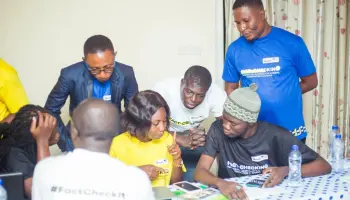
Several journalists from the Eastern, Central, Oti, Western, and Volta regions have attended a two-day training workshop on fact-checking methodology and reporting techniques to assist them in combating disinformation and improving rural development reporting.
The training, which was hosted in Koforidua, featured presentations and interactive sessions on several topics including modalities for identifying fake news, verifying sources, and incorporating data into reporting.
Dr Aurelia Ayisi, Lecturer, Department of Communication Studies, University of Ghana, and a facilitator for the workshop said, “We are now living our lives in the digital space and it’s important that we are conversant with technology, as well as fact-check information before we publish in order to keep ourselves safe and secured in our careers.”
To ensure consistency across fact-checks, she added that a good fact-check report must be well researched, analytical, clear, coherent, and well written.
She described fact-checking as the process of confirming the factual accuracy of a statement or piece of information, and that fact-checking plays a crucial role in promoting media literacy and combating the spread of misinformation, particularly in today’s era of information overload and fake news.
It helps people make informed decisions based on reliable and accurate information.
Dubawa – Ghana has therefore developed a standard to guide for fact-checking reports that include “title, claim, verdict, full text, verification and conclusion.”
Dr. Ayisi also highlighted the endemic nature of information disorder, noting that misinformation, disinformation, and malinformation constituted some of the conditions of information disorder.
She further emphasised the need for media literacy and critical thinking skills to combat information disorder and promote a healthy information ecosystem as well as educating people on how to identify and verify credible sources of information in addition to developing fact-checking skills to prevent the spread of false information.
Additionally, she recommended that journalists and media organisations should take responsibility in addressing information disorder by implementing measures to curb the dissemination of misleading content.
Dr. Theodora Dame Adjin-Tettey, a lecturer at the University of Ghana’s Department of Communication Studies, also urged the media and the general public to be wary of cyber security crimes, warning that information requiring a password could be found on devices, such as computers and mobile phones, and that “if we do not exercise caution, we risk becoming victims of fraudsters and kidnappers.”
The workshop was organized by Dubawa – Ghana, a fact-checking organisation, Department of Communication Studies, University of Ghana and United Nations Educational, Scientific and Cultural Organisation’s (UNESCO) International Programme for the Development of Communication (IPDC).
Media representatives from the Ghana News Agency, UTV, Ananse FM, Look FM, Daily Graphic, Joy News, and Radio Ahanta left the workshop equipped with new strategies to better serve their communities and provide accurate and reliable news.
The participants were separated into four groups for hands-on sessions where they practiced utilising digital fact-checking tools. They also identified statements for fact checking and reviewed fact-checking processes and sources.

