

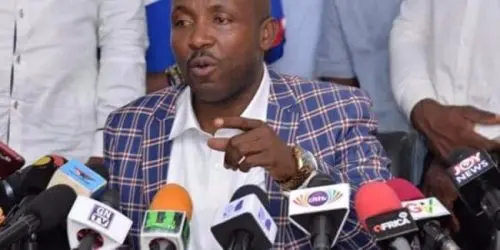
John Boadu, former General Secretary of the New Patriotic Party (NPP), has entered the Big Push procurement debate, arguing that the scale of sole-sourced contracts under the National Democratic Congress (NDC) administration is creating fertile ground for politically connected individuals to benefit from public funds at the expense of value for money.
Speaking on Oman FM on Monday, Boadu drew a clear line between lawful emergency procurement and what he described as systematic bypassing of competitive tendering. “If there is an emergency, like a collapsed public building or urgent road work, you cannot wait for long procurement processes,” he said, pointing to Sunday’s school building collapse at Accra New Town as an example of the kind of situation that genuinely justifies single sourcing. Outside such circumstances, he argued, open tender must be the rule.
His comments come six days after The Fourth Estate published an investigation, drawing on data obtained through Right to Information requests, which revealed that approximately 76 percent of contracts awarded under the Big Push road programme between September 2025 and January 2026 were through sole sourcing, with 81 out of 107 road contracts valued at over GH¢73 billion awarded without competitive bidding.
Boadu questioned the capacity of firms benefiting from the programme. Companies barely a year old and with only a handful of staff were, he said, winning major infrastructure contracts, raising doubts about competence and value for money. “When you avoid competitive tendering, you deny the country the chance to choose the most capable contractor,” he said. He also rejected the argument that the funding arrangements behind the Big Push make the programme exceptional, stating that whether resources flow through the Ghana Education Trust Fund (GETFund), mineral royalties, or the Road Fund, the money remains public funds subject to the same accountability standards.
Boadu further challenged the NDC on consistency, arguing the party cannot credibly criticise procurement practices it now replicates. The NDC, while in opposition, described inflated sole-sourcing contracts as a tool for corruption and a cause of billions of cedis in losses to the state. At his 2026 State of the Nation Address, President John Dramani Mahama himself renewed a pledge to bring legislation banning sole-sourced contracts except in exceptional circumstances.
The Roads and Highways Minister, Kwame Governs Agbodza, has contested the Fourth Estate’s figures, telling Parliament that only 44 percent of major contracts were sole-sourced and that more than 400 contracts were awarded through open competitive tendering. Ghana GoldBod Chief Executive Sammy Gyamfi has also defended the government’s record, insisting all sole-sourced contracts received Public Procurement Authority approval and underwent value for money audits, and that urgency fully justified the procurement method used.
The Minority in Parliament has separately called on the government to publish full contract details, arguing that transparency is essential for Ghanaians to independently assess the Big Push initiative’s impact.

