

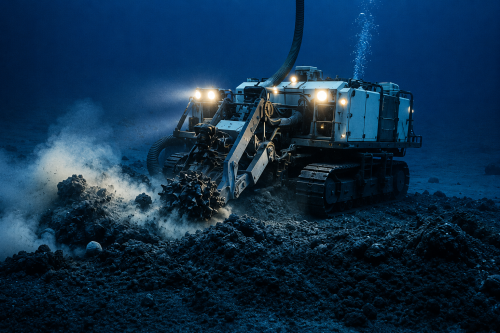
Environmental groups are pressing Indonesia to support a global pause on commercial deep sea mining before a decisive UN seabed summit in July.
The call places Jakarta in a delicate position. Indonesia produced more than half of the world’s nickel supply in both 2023 and 2024, commanding global prices and shaping supply chains for electric vehicles and battery technology. The minerals targeted in deep sea mining proposals, including nickel, cobalt, copper and manganese, are the same ones underpinning that land dominance. Commercial extraction from the ocean floor, if approved at scale, would create internationally accessible alternative supplies competing directly with Indonesia’s operations on land.
The Publish What You Pay (PWYP) Indonesia Coalition is pushing Jakarta to use its seat on the International Seabed Authority (ISA) Council, which it holds through 2026, to back a moratorium or precautionary pause on seabed extraction. ISA is the UN body responsible for regulating mining in international waters. It is finalising a Mining Code for commercial exploitation of the seabed, with negotiations on environmental safeguards, liability, inspections and benefit sharing arrangements all unresolved after years of talks.
PWYP Indonesia National Coordinator Aryanto Nugroho warned that the campaign was designed to highlight “the potential threats of massive ecological damage” from commercial deep sea mining if the July meeting moves forward without adequate scientific grounding.
That meeting carries weight beyond the Mining Code itself. ISA’s Legal and Technical Commission (LTC) is expected to deliver its final report on a potential compliance breach by Nauru Ocean Resources Inc. (NORI), a subsidiary of Canadian mining firm The Metals Company. NORI pursued a parallel domestic US approval process that critics and legal experts say sidesteps the ISA framework. The July session is also when NORI’s ISA exploration contract is due for extension. If breaches are confirmed, the pressure on ISA to act, including potentially terminating contracts, will be substantial. It would be the first major enforcement action in the authority’s history.
The environmental stakes centre on the Clarion-Clipperton Zone, a stretch of the Pacific Ocean between Hawaii and Mexico. The zone is estimated to contain more copper, cobalt, nickel and manganese than all known land deposits combined, according to figures published by the US Congressional Research Service. The extraction method targets polymetallic nodules, formations resembling rocks found thousands of metres below the surface. A study published in the journal Nature found that areas disturbed in seabed mining experiments more than 40 years ago continue to show ecological damage today, including altered sediment conditions and population declines among larger organisms.
The International Union for Conservation of Nature has warned that deep sea mining could drive biodiversity loss, generate sediment plumes affecting marine life across large areas, and disrupt ecosystems that remain among the least surveyed environments on Earth.
A second front complicating ISA negotiations opened when the US, which has never ratified the UN Convention on the Law of the Sea and carries no ISA voting rights, moved in 2025 to grant its own domestic licences for seabed mining through the largely dormant Deep Seabed Hard Mineral Resources Act. Legal experts have warned that if companies attempt to mine without ISA authorisation, it would constitute an unauthorised appropriation of the global commons under the UN Convention on the Law of the Sea.
More than 40 countries now back some form of precautionary pause or moratorium, with France, Germany, Brazil, Mexico, Costa Rica, Palau and South Africa among those raising fundamental scientific and governance concerns at ISA sessions. Seventy businesses have separately signed a statement calling for a halt to seabed mining activities.
The July session will consider a revised consolidated draft of the Mining Code, prepared ahead of the meeting as a basis for negotiations. Whether that text resolves years of deadlock or the moratorium coalition blocks commercial approval once more may determine the future of an industry that has never extracted a tonne of ore from the deep ocean floor.

