

Ghana’s financial markets delivered a mixed but broadly resilient performance in the latest trading week, with the Ghana Stock Exchange (GSE) extending a powerful rally and secondary bond market volumes surging, even as the government fell short of its Treasury bill target and the cedi softened against the dollar and pound.
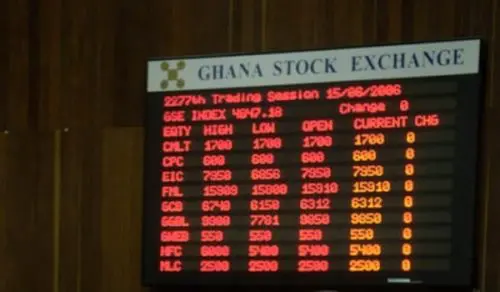
The GSE Composite Index (GSE-CI) closed the week at 15,130.52 points, posting a year-to-date return of 72.52%. Financial and information technology stocks continued to lead the advance, reflecting sustained investor confidence in those sectors. Among the top individual performers, ZEN advanced 12.66% to close at GH¢6.14, while Clydestone (CLYD) gained 11.11% to GH¢1.60, taking its year-to-date return to an extraordinary 247.83%. SIC Insurance posted a year-to-date gain of 370.83%, closing the week at GH¢5.65 after a 5.02% weekly rise. Losses on the exchange were contained, with the largest single-week decline limited to 0.18%. Total trading volumes moderated, falling 15.11% week-on-week to 11.51 million shares, with value traded reaching approximately GH¢86.54 million.
On the fixed income primary market, investor demand for Treasury bills on the Ghana Fixed Income Market (GFIM) edged up from GH¢4,433.95 million to GH¢4,488.36 million, but remained below the government’s target of GH¢5,009.00 million, producing an undersubscription of 10.39%. Despite the shortfall, acceptance rates were strong. Approximately 99.74% of bids for the 91-day bill were accepted, all bids for the 182-day bill were taken up, and 97.51% of the 364-day bill bids were absorbed.
Interest rates edged higher across the yield curve. The 91-day bill held at 4.92%, the 182-day instrument rose by one basis point to 6.97%, and the 364-day bill climbed eight basis points to close at 10.20%. The government is targeting GH¢4,349.00 million at the next auction.
The secondary market told a sharply different story. Trading volumes on the GFIM surged 201.1% week-on-week to reach GH¢6.76 billion, signalling active portfolio management and continued appetite for existing government securities. Treasury bills accounted for 43.19% of secondary market volumes, followed by Domestic Debt Exchange Programme (DDEP) bonds at 34.68%, reflecting ongoing investor interest in restructured sovereign debt. Sell-buy-back transactions made up 21.67% of activity.
On the currency front, the cedi weakened 0.86% against the US dollar to close at GH¢11.19, bringing its year-to-date depreciation against the dollar to 6.61%. Against the British pound, it fell 1.40% to GH¢15.20, with a year-to-date loss of 7.51%. The cedi posted a modest gain against the euro, rising 1.04% to GH¢13.13, though it remains 6.52% weaker against the European currency on a year-to-date basis. Open market indicative rates put the cedi at GH¢11.38 to the dollar, GH¢15.42 to the pound, and GH¢13.38 to the euro.

