

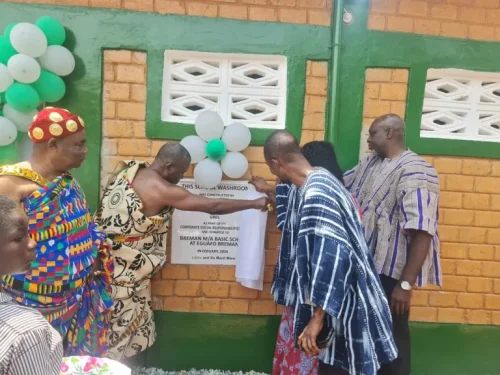
Ghana Rubber Estates Limited (GREL) has commissioned a sanitation facility worth GH₵272,000 at the Eguafo Breman Kindergarten School in the Central Region, extending a pattern of community infrastructure investment in communities that host its operations.
The facility includes a water storage tank and a mechanised borehole designed to provide pupils with a reliable, clean and dignified sanitation environment.
Perry Acheampong, Corporate Affairs Manager of GREL, noted that the intervention builds on the company’s earlier support to the community, when it constructed a six-unit kindergarten school block for the same school in 2019 at a cost of GH₵340,000. He said the combined investment reflects the company’s belief that access to proper sanitation and adequate infrastructure are prerequisites for effective teaching and learning, particularly for young children.
The Eguafo Breman project is part of a wider corporate social responsibility (CSR) programme that spans 90 communities across 10 Paramount Traditional Areas in the Western, Central and Eastern Regions. The company organises vacation classes for around 6,000 children each year in its operational area and awards scholarships to 30 secondary school students and five tertiary students annually.
The Municipal Director of Education for the Komenda-Edina-Eguafo-Abrem (KEEA) Municipality, Madam Mercy Ekua Lisa, praised the investment, saying that education thrives in environments that are safe, clean and supportive.
The Chairman of the Association on Whose Land GREL Operates (ACLANGO), Nana Kwesi Agyeman IX, commended the company for its development interventions and called on school authorities to maintain the new facility. The Chief of Eguafo Breman, Nana Gyan Dadzie I, echoed the appreciation, saying that most households in the community do not have access to comparable sanitation, and pledged that the facility would be put to good use.
Municipal Chief Executive Ishmael Saheed Zakour applauded the gesture and emphasised that a strong maintenance culture would be essential to ensure the facility serves pupils over the long term.
Acheampong also used the occasion to underscore the broader economic role of the rubber sector, noting that thousands of outgrower farmers sustain GREL’s operations and contribute to national growth. The 2026 national budget introduced a policy to restrict raw rubber exports and prioritise domestic processing, with the goal of reversing losses estimated at around US$100 million annually from limited value addition in the sector.

