

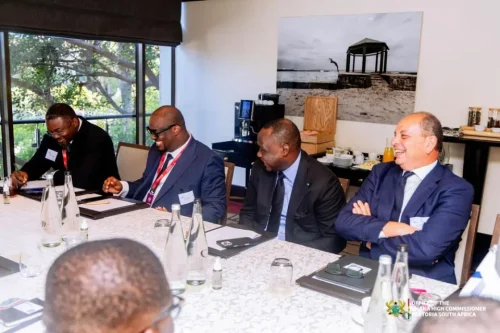
Ghana’s Minister for Lands and Natural Resources, Emmanuel Armah Buah, has held strategic talks with the African Export-Import Bank (Afreximbank) on financing and policy collaboration to develop the country’s minerals sector, with discussions focusing on advancing priority projects in gold, bauxite, and iron ore.
The bilateral meeting took place on Monday, February 9, 2026, on the opening day of the Investing in Africa Mining Indaba in Cape Town, South Africa, and centered on mobilizing long term funding, supporting value addition, and strengthening regional minerals supply chains to enhance Africa’s competitiveness in global markets.
Minister Buah briefed Afreximbank officials on Ghana’s Responsible Cooperative Mining and Skills Development Programme (rCOMSDEP), a flagship initiative aimed at formalizing artisanal and small scale mining, improving traceability, and promoting responsible gold production through shared processing infrastructure and access to finance.
The program, which was launched on August 6, 2025, seeks to transform artisanal mining by establishing locally owned cooperatives that receive professional training, legal concessions, and access to shared processing facilities equipped with modern mercury free technologies. The initiative aims to improve gold recovery rates, eliminate harmful mining practices, and diversify livelihoods through skills development.
rCOMSDEP is structured around six key pillars including cooperative mining schemes with centralized processing, technical support services, vocational training and entrepreneurship, environmental rehabilitation, agricultural value chain development, and community infrastructure projects. The program is expected to launch over 200 new cooperatives by the end of February 2026, according to rCOMSDEP Communications Director John Afful.
During the meeting, Minister Buah invited Afreximbank to support a proposed gathering of African ministers responsible for mining, an initiative intended to promote policy harmonization, deepen continental coordination, and create a more aligned regulatory and investment environment for Africa’s minerals sector.
The Afreximbank delegation was led by Senior Vice President Denys Denya and included Helen Brume, Director and Global Head of Business, Nana Addo Shepard Muridzi, Senior Special Assistant to the Senior Vice President, and Nana Odei, Senior Manager for Business Development at Afrexinsure.
Ghana is seeking to expand domestic value addition in its minerals sector as part of a broader strategy to boost export earnings, formalize small scale mining, and strengthen its role in regional supply chains. The country produces approximately 4.2 million ounces of gold annually, making it Africa’s largest gold producer and the world’s sixth largest.
The government estimates that approximately one million people work directly in artisanal mining, commonly known as galamsey, with up to 4.5 million dependent on the activity for their livelihoods. However, widespread mercury use in illegal operations has contaminated waterways and degraded farmland, particularly threatening cocoa production.
rCOMSDEP replaces two previous initiatives, the Community Mining Scheme (CMS) and the National Alternative Employment and Livelihood Programme (NAELP), and incorporates lessons learned while addressing their shortcomings through improved coordination and efficient resource utilization.
The program received Cabinet approval in July 2025 and aligns with President John Dramani Mahama’s vision to create sustainable jobs through responsible cooperative mining. Revenue from cooperative mining enterprises will be channeled into community development projects including water systems, health facilities, schools, and renewable energy initiatives.
The World Gold Council has partnered with Ghana to support the initiative through technical assistance and market linkages, while the Ghana Chamber of Mines has endorsed the program as a bold and visionary step toward responsible mining.
Minister Buah emphasized that the program represents a transformation of livelihoods, communities, and ecosystems rather than simply mining reform, stating that Ghana had reached a turning point where mining must shift from being a curse on the land to a catalyst for national prosperity.
The engagement with Afreximbank is part of Ghana’s broader efforts to attract strategic investment partnerships during the Mining Indaba conference. The Minister is leading a comprehensive Ghanaian delegation that includes heads of key implementing agencies such as Isaac Tandoh of the Minerals Commission, Ama Mawusi Mawuenyefia of rCOMSDEP, Dr. Prosper Akaba of the Ghana Geological Survey Authority, and Williams Okofo Dateh of the Ghana Integrated Iron and Steel Development Corporation (GIISDEC).
Afreximbank, established in 1993, is a pan African multilateral financial institution with a mandate to finance and promote intra African and extra African trade. The bank has provided significant financing to mining and resource development projects across the continent, positioning it as a strategic partner for Ghana’s minerals sector transformation agenda.
The Mining Indaba 2026, themed Stronger Together: Progress through partnerships, has attracted more than 10,500 delegates including government officials, industry leaders, investors, and regulators, making it the largest attendance in the event’s 32 year history. The four day conference runs from February 9 to 12, 2026, and serves as Africa’s premier platform for mining investment, policy dialogue, and sustainable resource development.

