

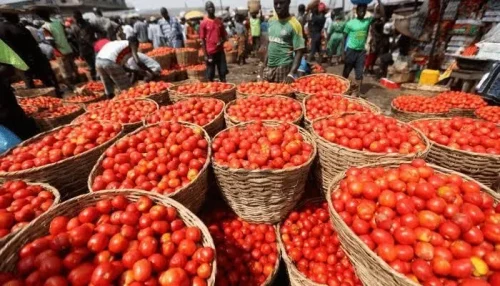
Ghana has formally raised its dependence on Burkina Faso for tomato imports at the World Trade Organization’s (WTO) 14th Ministerial Conference (MC14) in Yaoundé, urging Ouagadougou to reconsider a supply ban that threatens a supply chain valued at approximately 400 million dollars annually.
Trade, Agribusiness and Industry Minister Elizabeth Ofosu-Adjare held bilateral talks with a Burkinabè delegation on the sidelines of MC14, which took place from March 26 to 29 in Yaoundé, Cameroon, the first time the WTO’s highest decision-making gathering has been hosted on African soil. The discussions brought together parliamentary committee members from both countries alongside officials from key ministries, departments and agencies.
At the heart of the exchange was a directive issued on March 16 by the transitional government in Ouagadougou. A joint communiqué signed by Industry Minister Serge Gnaniodem Poda and Agriculture Minister Commandant Ismaël Sombie suspended all fresh tomato exports across Burkina Faso’s entire national territory until further notice, halting the issuance of Special Export Authorisations with immediate effect and giving operators holding existing permits only two weeks to complete pending shipments.
The directive lands hardest on Ghana, which relies on Burkina Faso for between 70 and 80 percent of its fresh tomato supply. Trade data confirms that Burkina Faso has in recent years exported nearly all of its fresh tomatoes to Ghana, making Accra the dominant and effectively sole destination for its cross-border tomato flows.
Burkina Faso’s rationale, however, is grounded in its own industrial development logic. The policy reflects a deliberate pivot away from raw material export toward domestic agro-processing. The centrepiece of the strategy is a trio of processing plants financed through a community shareholding model, including SOFATO in Yako and SOBTO in Bobo-Dioulasso, which is already producing the “A’diaa” brand of tomato concentrate. A third major facility in Tenkodogo, known as SOBTO2, has surpassed 70 percent completion with machinery installation underway. The facilities are designed to eliminate the country’s historic dependence on imported tomato paste, which averaged more than 15,000 tonnes annually between 2020 and 2024, peaking at 26,451 tonnes in 2024.
In Yaoundé, the Burkinabè delegation explained the suspension in precisely these terms, describing it as a structural shift toward value addition and industrialisation rather than a trade restriction targeting any particular partner. Ofosu-Adjare acknowledged Burkina Faso’s expertise in tomato and onion production, expressed Ghana’s interest in learning from its farming practices, and called for collaborative solutions that address the concerns of both countries. She also raised the security situation in parts of Burkina Faso, noting that ongoing instability had disrupted cross-border trading activities and endangered Ghanaian traders operating in the country.
As a practical step toward deepening the bilateral relationship, the minister invited Burkina Faso to submit a list of its top ten import categories, enabling Ghanaian businesses to identify supply opportunities, and announced plans to bring between 20 and 50 Burkinabè traders to Ghana in the coming months to explore cross-sector commercial links.
Both delegations pledged to sustain dialogue, though no concrete timeline was given for lifting or modifying the tomato export ban.

