

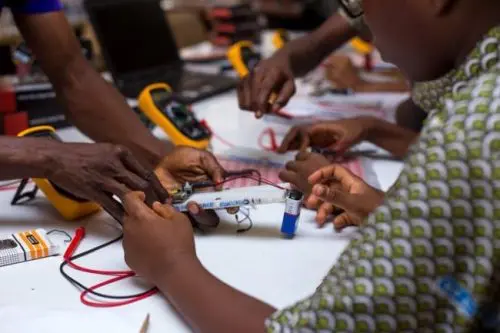
Ghana’s basic school pupils could soon study coding, artificial intelligence and technical skills after Education Minister Haruna Iddrisu announced a revised national curriculum Monday in Accra, pending Cabinet and parliamentary approval.
The change would touch every classroom from kindergarten to junior high school, making it one of the most consequential education decisions of the Mahama administration if it clears the approval chain. For parents, the practical question is when their children actually see these subjects, and on that the minister gave no date.
Speaking at the Government Accountability Series press briefing in Accra on Monday, July 20, Iddrisu said the document, drafted by the National Council for Curriculum and Assessment (NaCCA), will go to the Ministry of Education before submission to President John Dramani Mahama, then Cabinet and Parliament for approval. He confirmed the formal presentation happens Wednesday.
“We have promised to introduce coding, electronics, artificial intelligence and TVET,” the minister said, referring to Technical and Vocational Education and Training. He described the NaCCA document as a “smart start curriculum” meant to strengthen science, technology, engineering and mathematics teaching at the basic level, and said ethics, patriotism and civic responsibility would also become integral parts of the revised programme.
The announcement did not come from nowhere. Iddrisu first signalled plans to bring AI, robotics, coding and electronics into basic education at a digital education conference in Accra in June, and the National Curriculum Review Committee has since completed its work. The reform replaces arrangements built on the standards based curriculum introduced in 2019.
The minister’s own framing points to the hard part. He said basic education has received less investment than secondary education over the years, even though literacy, numeracy and critical thinking are built at that level. Teaching AI and electronics to kindergarteners demands trained teachers, electricity, devices and connectivity in thousands of schools where those remain scarce, and the ministry has not yet published a costed rollout plan, a teacher retraining schedule or an implementation date. Until Parliament approves the document, the promise remains a proposal.
Iddrisu paired the announcement with figures on girls’ education, saying the government has distributed 12.2 million sanitary pads nationwide to support about 2.5 million female students in basic and secondary schools, part of efforts to keep girls in class during menstruation.
The Wednesday handover starts the clock. What follows through Cabinet and Parliament, and what budget accompanies the document, will show whether this is a curriculum or a communiqué.

