

Ghana has secured a new International Monetary Fund (IMF) monitoring arrangement to protect economic gains after a three-year bailout, as inflation falls to 3.4% in April 2026 from crisis highs above 50% in December 2022.
The framework, known as the Policy Coordination Instrument (PCI), carries no fresh financing. It functions instead as a policy anchor, committing the government to fiscal discipline, inflation control, and structural reforms under regular IMF review after the Extended Credit Facility programme concludes this year.
The numbers behind the recovery are significant. Public debt as a share of Gross Domestic Product (GDP) has declined considerably, foreign reserves have reached an all-time high, and the cedi has held relative calm, drawing cautious investor interest back to the country.
But Ghana arrives at this milestone carrying a well-documented liability: a generational pattern of election-year spending that has repeatedly erased hard-won fiscal progress. Governments across party lines have consistently expanded expenditure ahead of votes through infrastructure announcements, public sector recruitment, subsidies, and social programmes. The consequences have followed an equally consistent sequence: widening deficits, rising debt, inflationary pressure, and eventual recourse to IMF support.
The 2016 election year illustrated the pattern sharply. Wage pressures, energy obligations, and capital commitments pushed the fiscal deficit beyond programmed targets. The damage surfaced years later in elevated borrowing costs, cedi weakness, and renewed economic vulnerability. Even in 2024, when Ghana was under active IMF monitoring, off-budget commitments, arrears accumulation, and politically driven expenditure decisions still emerged.
The PCI differs from a traditional bailout in one critical way: its entire effectiveness rests on political will rather than loan conditionality. With no disbursements tied to compliance, economists warn the framework may struggle to hold as campaign pressures build toward the 2028 election cycle.
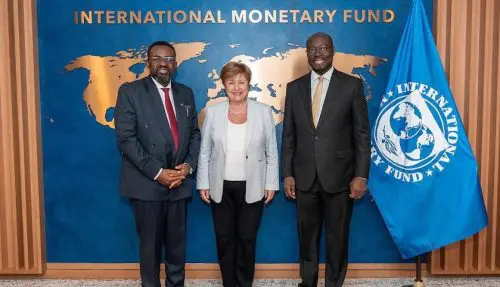
Bank of Ghana Governor Dr. Johnson Asiama, Finance Minister Dr. Cassiel Ato Forson, and IMF Managing Director Kristalina Georgieva have all been associated with the arrangement, signalling high-level commitment from both sides. Government officials maintain that economic stability remains the overriding priority.
Markets, however, are expected to judge Ghana not by those assurances but by actual spending behaviour as political competition intensifies. The country now holds a rare opening to break a cycle that has defined its economic history for decades. Whether the PCI becomes the institutional discipline that finally makes that break possible, or another framework overtaken by political pressure, may ultimately determine the durability of Ghana’s post-IMF recovery.

