

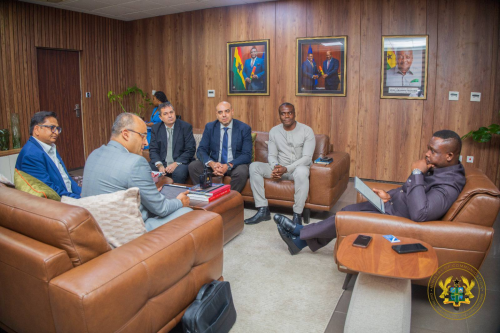
Ghana is intensifying efforts to fast track its digital transformation agenda through deeper collaboration with Nokia, as Communications Minister Samuel Nartey George met with the telecommunications giant’s delegation in Accra to discuss expanding cooperation in 5G deployment, broadband infrastructure, and innovation capacity building. The engagement signals government determination to leverage private sector expertise in modernizing national digital systems across healthcare, land administration, and public service delivery.
The high level meeting at the Ministry’s headquarters followed earlier discussions between both parties at Mobile World Congress in Barcelona, indicating sustained momentum in the partnership. Minister George praised Nokia’s long standing presence in Ghana’s telecommunications ecosystem, describing the Finnish technology company as a key partner supporting all major network operators in the country.
Nokia has maintained operations in Ghana since 1998, contributing to critical national infrastructure projects including the Eastern Corridor Fibre Network and what the company describes as the largest LTE rollout in Africa. This track record positions Nokia as a trusted technology partner as Ghana pursues ambitious digital transformation goals under the Mahama administration.
The discussions centered on several priority areas reflecting Ghana’s immediate infrastructure needs and longer term digital development objectives. Expanding 5G network deployment topped the agenda, with both parties recognizing that next generation mobile connectivity forms the foundation for innovation across multiple economic sectors. Ghana’s 5G rollout has faced delays and implementation challenges, making reliable technology partnerships essential for achieving nationwide coverage targets.
Fibre to home broadband expansion represents another focus area, addressing persistent gaps in fixed line internet access that limit remote work capabilities and digital service delivery in residential areas. While mobile internet has achieved broad penetration across Ghana, affordable high speed fixed broadband remains unavailable to most households, constraining the digital economy’s growth potential.
Data center development also featured prominently in discussions, reflecting government recognition that cloud computing infrastructure must support digital service expansion. As public and private sector entities increasingly migrate operations online, Ghana needs locally available data center capacity to ensure service reliability, data sovereignty, and reduced latency for critical applications.
Digital public safety systems aimed at improving emergency response coordination and national security capabilities received attention as well. Modern telecommunications infrastructure enables real time information sharing among security agencies, potentially transforming how Ghana responds to emergencies, natural disasters, and public safety threats.
Marco Rebecchi, Nokia’s Country Manager for Ghana and Nigeria, led the visiting delegation. He reaffirmed the company’s commitment to investing in local capacity building, highlighting Nokia’s newly completed Innovation Centre in Ghana as evidence of long term engagement beyond simple equipment supply. The facility will train engineers and support the Ministry’s ambitious One Million Coders initiative, which seeks to dramatically expand Ghana’s digital skills base.
The One Million Coders Programme represents a flagship element of government’s digital agenda, targeting training for one million Ghanaians, especially youth and women, in coding, artificial intelligence, and emerging technologies. Nokia’s Innovation Centre provides practical infrastructure for delivering technical training at scale, addressing the skills shortage that currently limits Ghana’s technology sector growth.
Both parties committed to deepening collaboration over the next twelve months, with particular emphasis on innovation, rural connectivity, and sustainable infrastructure development. This timeline suggests concrete deliverables should emerge by late 2026, providing measurable indicators of whether the expanded partnership produces tangible results beyond memoranda of understanding and policy statements.
Nokia extended an invitation for Minister George to visit the company’s Centre of Excellence in Finland, offering opportunities to explore additional technology partnerships and knowledge exchange. Such high level engagement signals Nokia’s view of Ghana as a strategic market worth senior management attention, not merely a commercial territory for regional sales teams.
The renewed partnership adds momentum to Ghana’s broader digital transformation strategy, which aims to position the country as a competitive digital hub in West Africa through public private collaboration. However, translating partnership announcements into operational infrastructure requires navigating familiar challenges including funding constraints, regulatory coordination, and implementation capacity.
Ghana’s digital ambitions extend well beyond telecommunications infrastructure. Minister George has articulated a vision positioning Ghana as West Africa’s artificial intelligence hub, with initiatives including a national AI Innovation Centre developed in partnership with MTN Ghana, a planned one billion dollar Ghana UAE Innovation and Technology Hub in Prampram, and legislative frameworks designed to enable emerging technology adoption through 2035.
The government’s approach emphasizes building local technological capacity rather than simply consuming foreign technology products. This philosophy aligns with continental initiatives under the African Union’s Digital Transformation Strategy and Smart Africa Alliance, both prioritizing indigenous innovation capability over dependency on external technology providers.
Yet execution remains the critical test. Previous governments announced similarly ambitious digital transformation initiatives that produced limited concrete results as implementation fell short of rhetoric. Success requires sustained funding, effective project management, and coordination across multiple government agencies with competing priorities and limited technical capacity.
The telecommunications sector provides some encouraging precedents. Ghana achieved bilateral roaming agreements with Côte d’Ivoire, Togo, and Benin, allowing Ghanaians to pay local mobile rates when traveling to neighboring countries. Negotiations with Nigeria continue, with implementation targeted before year end. These practical achievements demonstrate capacity to deliver operational improvements when focused effort aligns with clear objectives.
Infrastructure challenges persist despite progress. Most of Ghana’s internet exchange points currently operate from London and Portugal, increasing data travel time and costs while creating dependency on external infrastructure for domestic internet traffic. Government plans to localize internet traffic could significantly improve performance and reduce costs, but require substantial capital investment and technical expertise.
The partnership with Nokia specifically addresses this infrastructure gap. As a major telecommunications equipment vendor with extensive African experience, Nokia brings technical capabilities and implementation expertise that Ghana’s public sector lacks internally. The question is whether government can provide the policy stability, project funding, and institutional support needed to translate Nokia’s capabilities into functioning infrastructure.
Rural connectivity represents a particularly challenging aspect of Ghana’s digital agenda. While urban areas enjoy relatively robust mobile coverage and improving broadband access, rural communities often lack basic telecommunications infrastructure. Extending 5G and fiber networks to sparsely populated areas requires business models that justify commercial investment or government subsidies that stretch limited budgets.
The emphasis on sustainable infrastructure in partnership discussions suggests awareness that digital transformation must balance immediate deployment with long term operational viability. Networks require ongoing maintenance, periodic technology upgrades, and continuous investment that can strain both public budgets and private sector returns in emerging markets.
Nokia’s Innovation Centre and support for the One Million Coders initiative acknowledge that infrastructure alone cannot drive digital transformation. Human capital development matters equally, ensuring Ghanaians possess skills to build, maintain, and utilize advanced telecommunications networks. Without locally available technical expertise, Ghana risks perpetual dependency on foreign contractors for network operations and service delivery.
The twelve month timeline for deepening cooperation provides a concrete window for assessing progress. By late 2026, observers should be able to evaluate whether expanded Nokia partnership produced measurable improvements in 5G coverage, broadband penetration, data center capacity, and skills development. These metrics will determine whether current engagement represents genuine transformation or merely another round of aspirational announcements.
For Nokia, Ghana offers both commercial opportunity and strategic positioning. Success in Ghana enhances the company’s competitive position across West Africa, providing reference implementations for neighboring markets and demonstrating capacity to deliver complex projects in challenging environments. Ghana’s relative political stability and established telecommunications market make it an attractive partner compared to more fragmented or unstable regional alternatives.
The partnership ultimately depends on mutual commitment beyond initial enthusiasm. Ghana must deliver on policy frameworks, project approvals, and funding commitments that enable Nokia to deploy infrastructure commercially. Nokia must follow through on innovation center operations, skills development programs, and technology transfers that build local capabilities beyond simple equipment sales.
Whether this expanded partnership catalyzes genuine digital transformation or joins the archive of unfulfilled technology initiatives remains to be determined. The next twelve months will provide crucial evidence of whether government and Nokia can translate shared objectives into operational infrastructure, trained personnel, and improved digital services that tangibly benefit Ghanaian citizens and businesses.

