

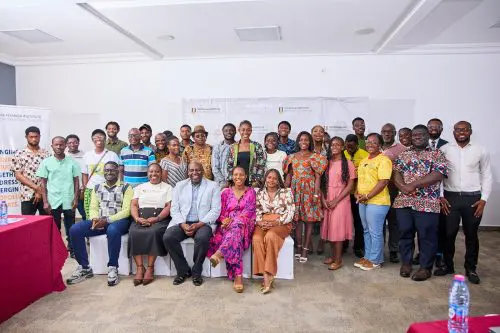
Ghana’s democracy looks strong at the ballot box but stands on weaker institutional ground than most acknowledge, panelists said at a Nyansa Institute for Strategic Dialogue forum in Accra last month, part of a series examining whether Ghana can anchor democratic governance for West Africa.
The June 26 event drew researchers, civil society figures, policymakers and students to discuss the question directly. Dr John Osae-Kwapong of The Democracy Project pointed to the Varieties of Democracy project’s decision to reclassify Ghana from a liberal democracy to an electoral democracy, citing weaknesses in rule of law and institutional independence. Ghana’s democracy has become too identified with elections, he said. The reclassification checks out against V-Dem’s own 2026 report, which groups Ghana with Botswana and South Africa among Sub-Saharan Africa’s electoral democracies, a tier below liberal democracy, with the Seychelles standing as the only country in the region V-Dem still classifies as a full liberal democracy.
Panelists identified three structural weaknesses behind that finding. Osae-Kwapong pointed to a gap between democratic aspiration and practice, noting that roughly seven in ten Ghanaians say they prefer democracy even as active civic participation, contacting officials, engaging local assemblies, stays low. Ransford Brobbey of the IMANI Centre for Policy and Education described a second problem he called catanomics, the pattern of incoming governments abandoning predecessor policies regardless of merit, which he said wastes resources and deepens public cynicism. Panelists also pointed to a dividends gap, arguing many Ghanaians, particularly younger citizens, do not feel democracy has delivered jobs, healthcare, education or security.
Theodora Williams Anti, executive director of the Foundation for Security and Development in Africa, linked democratic fragility directly to security, citing Burkina Faso, Mali and Sierra Leone as examples of how excluding young people economically can feed radicalization and instability. She argued Ghana should shift from a state centred security approach toward one centred on human security, pointing to the country’s fusion centre model, which combines intelligence and security agencies, as an approach worth expanding.
The dialogue closed with specific proposals rather than general calls for reform: a constitutional requirement for policy continuity across administrations, electing rather than appointing Metropolitan, Municipal and District Chief Executives, a national policy literacy programme, structured pathways for youth participation in governance bodies, and turning Ghana’s record on presidential term limits into a model other West African states could adopt. The dialogue was the second in a series the Accra based think tank plans to continue on governance, security and regional integration across Ghana and West Africa.

